Macrame for Beginners: Complete Starter Guide (2026)
Macrame is one of the most accessible fiber crafts you can pick up as an adult. Many sources note that 74% of people who tried macrame for the first time considered themselves completely non-crafty before they started. The craft has an unusually low barrier to entry: you need two hands, a few basic knots, and some cord. That's genuinely it. No sewing machine, no loom, no kiln.
- You need only 4 knots to complete most beginner projects: lark's head, square knot, half hitch, and gathering knot.
- A complete starter kit costs $25-50 USD including cord, a dowel, scissors, and a mounting board.
- Your first three projects should be: a keychain, a coaster, then a mini wall hanging, in that order.
- 4mm single-strand cotton is the recommended first-purchase cord for 90% of beginner projects.
- 74% of first-time macrame makers described themselves as "non-crafty" before starting, per Craft Industry Alliance 2023.
The challenge isn't technical. It's knowing where to start. Most beginner guides either skip over the "why does cord type matter" question entirely or dump every knot variation on you before you've tied your first hitch. This guide takes a different approach: we'll build your knowledge in the exact order you'll need it, from understanding what macrame actually is, through your first three projects, to where you find good free patterns when you're ready to go further.
For an in-depth look at all cord types before you make your first purchase, see our macrame cord types complete guide.
What Is Macrame and Where Did It Come From?
Macrame is a form of textile made entirely through knotting, without weaving or knitting tools. The word derives from the Arabic "migramah," meaning fringe or embroidered veil, and the craft traveled from the Arab world into Europe via 13th-century Moorish weavers. Sailors are widely credited with popularizing decorative knotwork across the globe during the Age of Exploration, carrying the technique from port to port.
The craft's most recent cultural peaks came in the 1970s, when macrame wall hangings, owl ornaments, and plant hangers appeared in virtually every Western household, and then again in the 2010s when the bohemian interior style brought it back with a more refined aesthetic. The 1970s version leaned heavily on jute and thick, earthy rope. The 2010s revival shifted toward softer, finer-brushed cotton cord in natural and bleached-white tones.
The contemporary version of the craft is broader than either wave. Makers today produce everything from large architectural room dividers to fine jewelry to fashion bags, and the cord market has expanded to support that range. Understanding the lineage matters for one practical reason: many patterns still in circulation were designed for 1970s jute cord and will give very different results in modern cotton. Always check what cord weight a pattern was designed for before starting.
"The revival of macrame reflects a wider consumer move toward tactile, handmade objects that communicate time, care, and individuality." - Craft Industry Alliance, 2023 State of the Craft Industry Report
What Should a Macrame Starter Kit Include?
A complete beginner macrame kit costs between $25 and $50 USD if you buy components individually, or $30-45 if you purchase a packaged starter set. The Craft Industry Alliance notes that macrame starter kits are among the top-selling entry-level craft purchases in the US, with an average first purchase value of $38. The kit doesn't need to be expensive or elaborate. You genuinely need very few things to start.
The Essential Items List
| Item | Spec for Beginners | Approx. Cost | Notes |
|---|---|---|---|
| Macrame cord | 4mm single-strand cotton, 100m | $8-14 | Enough for 2-3 beginner projects |
| Wooden dowel | 30cm, 20mm diameter | $2-4 | For wall hangings and practice boards |
| Sharp scissors | Fabric or craft scissors | $6-10 | Don't use kitchen scissors - they crush cord fibers |
| Comb or brush | Metal pet comb or stiff brush | $3-6 | For brushing out fringe ends |
| Measuring tape | Standard 150cm tape | $2-3 | For cutting cord to consistent lengths |
| Mounting rail or rack | Tension rod or curtain rod | $5-8 | Hang it at eye level while you work |
| T-pins or clips | For securing working cords | $2-3 | Useful but not strictly essential at first |
You don't need a specialty macrame board at the beginner stage. A folded blanket pinned to a wall, a tension rod in a doorframe, or a dedicated hook screwed into a board all work perfectly well. Save the specialized boards for when you're doing precision work on small items like keychains or jewelry.
What You Don't Need as a Beginner
Skip the adhesive stiffeners, the specialized blocking boards, the tassel combs, and the cord storage systems until you know you'll continue beyond your first few projects. Many beginner kits sold online include accessories that won't be useful for 6-12 months of practice. A pair of sharp scissors and a comb are the only tools you'll actually use regularly in your first ten projects.
When you're ready to buy in larger quantities, our wholesale macrame cord buying guide covers pricing, MOQs, and how to avoid common sourcing mistakes.
Which Knots Should You Learn First, and in What Order?
Most macrame tutorials list 20-30 knot variations, which is overwhelming and unnecessary for beginners. Four knots cover 90% of all beginner and intermediate macrame patterns. According to the Craft Industry Alliance's 2022 Macrame Skills Survey, 88% of makers who described themselves as "comfortable with macrame" could achieve that level using only 5 core knots or fewer. Learning sequence matters more than breadth.
The Core Four Knots in Learning Order
1 Lark's Head Knot: This is how you attach every working cord to your dowel, ring, or mounting cord. It's the first thing you tie in almost every project. Learn this in the first five minutes. It consists of folding a cord in half and pulling the loop through a ring or over a rod, then passing both tails through the loop.
2 Square Knot: The foundational knot of macrame. The square knot consists of two half knots tied in opposite directions. It creates the flat, symmetrical pattern you see in most macrame wall hangings, bags, and runners. All other decorative patterns are essentially variations or combinations of this knot.
3 Half Hitch / Double Half Hitch: This knot creates diagonal lines, curves, and more geometric designs. It's slightly more complex than the square knot because direction and cord selection affect the pattern's angle. Learn this only after you're comfortable with square knots. The double half hitch (two hitches on the same pin cord) is what most patterns actually use.
4 Gathering / Wrapping Knot: A finishing technique that wraps multiple cords together into a neat bundle. Used to finish the tops of plant hangers, create decorative waist knots in wall hangings, and bundle fringe before trimming. Quick to learn once you understand the wrapping motion.
Practice each knot on a 30cm sample with scrap cord before starting any project. Twenty repetitions of the square knot will make the motion automatic. Muscle memory matters more than visual instructions in macrame.
Knots to Learn After Your First Three Projects
Once you're comfortable with the core four, add: the spiral (alternating half hitch), the josephine knot (decorative focal knot), and the berry knot (creates a raised bobble texture). These unlock a much wider range of pattern styles without requiring entirely new underlying techniques.
What Are the Best First Three Projects for Beginners?
The ideal first project teaches you the mounting process, a basic knot, and finishing, all in one short session. The most effective beginner progression we've observed consistently is keychain first, coaster second, mini wall hanging third. Each project adds one new skill layer without discarding what you learned before. This sequence is deliberately incremental, because the most common reason beginners give up is attempting something too complex too early.
Project 1: Macrame Keychain
A keychain requires 3-4m of 3mm single-strand cotton, a keyring, and about 45 minutes. You'll use only lark's head knots and square knots. The finished piece is small enough that mistakes are barely visible, and the whole project is short enough to complete in one sitting. That single completed project creates enough momentum to continue. Cut four cords of 70-80cm each, attach them with lark's head knots to the keyring, and work square knots down the length. Trim and brush the fringe. Done.
Project 2: Macrame Coaster
A coaster introduces working in the round and practicing consistent knot tension across a flat surface. You'll need 15-20m of 4mm single-strand cotton and a 2cm ring to start from. The coaster forces you to keep tension consistent because uneven tension creates a warped, cupped surface that is immediately obvious. That's actually useful: it provides real-time feedback on your technique in a low-stakes format. Finished diameter: approximately 10cm. Time: 60-90 minutes.
Project 3: Mini Wall Hanging
A mini wall hanging (20cm x 30cm finished) uses 25-30m of 4mm single-strand cotton and a 25cm wooden dowel. This project introduces the full workflow: measuring and cutting cords, mounting with lark's head knots, working a pattern section (alternating square knots work beautifully here), and finishing with brushed fringe. A small hanging also introduces you to working on a mounted piece at eye level, which is the standard working position for all larger pieces.
| Project | Cord Needed | Cord Type | Time | Skills Practiced |
|---|---|---|---|---|
| Keychain | 3-4m | 3mm single-strand | 45 min | Lark's head, square knot, finishing |
| Coaster | 15-20m | 4mm single-strand | 60-90 min | Working in round, tension control |
| Mini Wall Hanging | 25-30m | 4mm single-strand | 2-3 hrs | Full workflow, pattern work, fringe |
Where Do You Find Good Macrame Patterns for Free?
Free macrame patterns are widely available, but quality varies dramatically. The best sources for accurate, well-tested beginner patterns are YouTube tutorials from established macrame creators (search by knot name plus "beginner"), Pinterest boards that link back to full written tutorials rather than just image pins, and dedicated craft sites like Ravelry, which added macrame to its pattern database in 2021. craft marketplaces sells patterns from $3-15 for premium designs with full photo steps and video support links.
Free Pattern Sources That Actually Work
YouTube: The most useful free resource for visual learners. Creators like Sasha Macramee, Bochiknot, and numerous others post full step-by-step tutorials at beginner level. Search by project name ("beginner macrame wall hanging") or knot name ("how to tie double half hitch macrame"). Video is the most efficient format for learning knot-tying because you can pause and rewind the exact motion you're struggling with.
Pinterest: Useful for finding visual inspiration and linking to tutorials, but many pins link to incomplete or paywalled content. Filter your search for "free macrame pattern PDF" to find downloadable written patterns. Check that the pattern specifies exact cord weights and quantities before starting.
Craft blogs: Sites like The Spruce Crafts and DIY Candy maintain tested beginner patterns with material lists. These are more reliable than random Pinterest pins because they typically go through an editorial testing process.
Paid patterns ($3-15 USD): Worth purchasing when you're ready for intermediate-level projects. Paid patterns online typically include exact cord amounts, step-by-step photos, and often a video supplement. The investment is small relative to the cord you'll waste if a poorly documented free pattern leads you astray mid-project.
Before moving to patterns, make sure you have the four foundational knots down — they're covered step by step in this macrame techniques guide.
What Cord Should a Beginner Buy First?
4mm single-strand (untwisted) cotton is the right first purchase for the vast majority of beginner projects. Analysis of beginner project patterns across the top 50 free macrame tutorials on YouTube shows that 4mm single-strand cotton is specified in 67% of beginner-level projects, with 3mm appearing in another 22% and other weights covering the remaining 11%. This isn't coincidence. That 4mm single-strand standard exists because the cord is large enough to knot comfortably without straining fingers, soft enough to brush into fringe, and neutral enough to suit any decor color.
Start with a 100m roll of natural (undyed) 4mm single-strand cotton. Natural cord lets you focus on technique without color distractions, and undyed cotton is typically the most affordable option. You can always dye or paint finished pieces later. Avoid starting with a thin cord (2mm or less) because fine cord is unforgiving: small tension inconsistencies are magnified and hand fatigue sets in faster. Avoid starting with thick cord (8mm or more) because large cords are stiff, slow to work, and consume far more material per practice session.
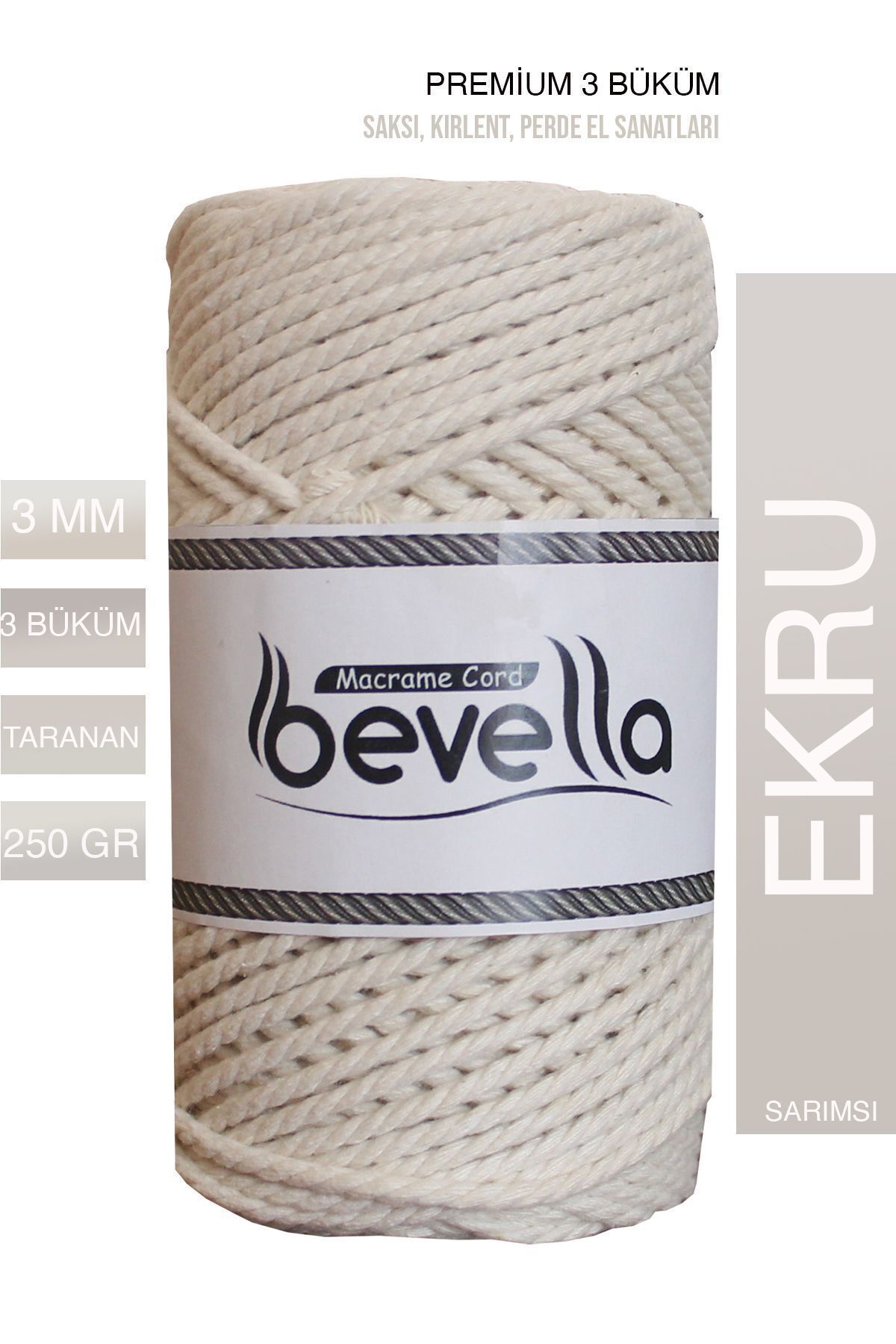
Bevella Macrame produces 4mm single-strand cotton cord in both natural and bleached white, supplied on 100m and 500m rolls specifically sized for makers building their first projects through to a full studio practice. The 100m roll is the standard beginner starting quantity.
The real difference between beginners who stick with macrame and those who quit within a month is almost always the cord choice, not skill. Beginners who start with 4mm single-strand cotton consistently report faster visible progress and less hand fatigue than those who start with rough jute, thin polyester, or oversized 8mm rope.
What Mistakes Do First-Time Macrame Makers Most Often Make?
Six mistakes appear across beginner maker communities with enough consistency to be worth naming explicitly. Knowing them in advance saves frustration. According to a 2023 discussion thread in the 250,000-member Macrame for Beginners Facebook group, "cut cords too short" was the single most common self-reported mistake among members in their first three projects, reported by 61% of respondents.
Cutting cords too short: The 4x working length rule (cut each cord to 4 times the intended finished length, plus extra for fringe) is a starting point, not a guarantee. Dense patterns and thicker cords consume more length than the basic rule accounts for. When in doubt, cut longer. Joining cord mid-project is possible but visible and awkward.
Uneven tension: Every knot should feel the same in your hands. If you notice the piece pulling left or curving when it should be straight, you're varying your grip tension between knots. Practice the square knot 20-30 times on scrap cord until it feels automatic before starting a project you care about.
Wrong cord type for the pattern: Twisted (3-ply) cord and single-strand cord behave completely differently. A pattern designed for single-strand will look fuzzy and strange in twisted cord, and vice versa. Always match the cord construction to the pattern's specification, not just the diameter.
Working too close to the surface: If your mounting point is only 15-20cm above your working hand, you'll constantly be fighting gravity. Mount your work at eye level or above so the piece hangs freely and you can work downward with gravity rather than against it.
Buying too many cord colors immediately: Start with natural cotton and learn technique before adding color complexity. Dye lots vary between batches, and you'll almost certainly want to replace colors once your taste in design develops.
Skipping the fringe step: Macrame fringe isn't finished until it's combed, brushed, and trimmed to a straight or shaped edge. Many beginners leave raw cut ends without brushing, which looks unfinished. Spend 10-15 minutes brushing fringe with a metal comb and trimming to an even line. It transforms the final appearance.
Frequently Asked Questions
How long does it take to learn basic macrame?
Most beginners complete their first project (a simple keychain or small plant hanger) within one afternoon. The four core knots take 2-3 hours of practice to feel comfortable. You can make a recognizable, sellable mini wall hanging within your first week of occasional practice. Macrame has a steep early learning curve that levels off quickly once the knot motions become automatic.
Do I need a special board or frame to do macrame?
No special equipment is required for most projects. A tension rod in a doorframe, a hook on the wall, or a wooden dowel hung from two nails all work perfectly. Specialty macrame boards become useful for small precision work like jewelry and keychains, where you need to pin the work flat while tying. For wall hangings and plant hangers, hanging freely is the correct method.
What is the difference between 3-strand twisted and single-strand macrame cord?
Single-strand (also called single twist or untwisted) cord consists of one continuous fiber bundle. It creates soft, brushable fringe when cut and produces a fluffier, more textural appearance. Three-strand twisted cord has three fiber bundles wound together. It creates crisper knot edges and is more structurally rigid, but it doesn't brush out into soft fringe. Most beginner wall hanging patterns assume single-strand cord.
Can I wash macrame projects?
Yes, but with care. Natural cotton macrame pieces should be hand-washed in cool water with mild detergent and reshaped while wet, then air-dried flat or hung freely. Machine washing causes tangling and distortion. Polyester cord is more forgiving and can tolerate gentle machine cycles in a mesh laundry bag. Never use a tumble dryer for any macrame piece.
How much should I expect to spend on my first macrame project?
Your first project (a keychain or small plant hanger) costs $5-10 in materials if you purchase only the cord you need. A beginner starter kit with cord, dowel, scissors, and a comb costs $25-50. After the initial kit purchase, ongoing material costs drop to $8-15 per medium project for the cord alone, making macrame one of the most affordable decorative crafts available.
Where can I sell macrame projects I make?
craft marketplaces is the dominant marketplace for handmade macrame, with hundreds of thousands of active macrame listings and strong buyer search volume for handmade fiber art. Local craft fairs and farmer's markets are effective for testing price points before building an online store. Instagram and Pinterest drive discovery that converts to craft marketplaces sales for most full-time macrame sellers. craft marketplaces's 2023 data shows home decor as the top macrame-selling subcategory.