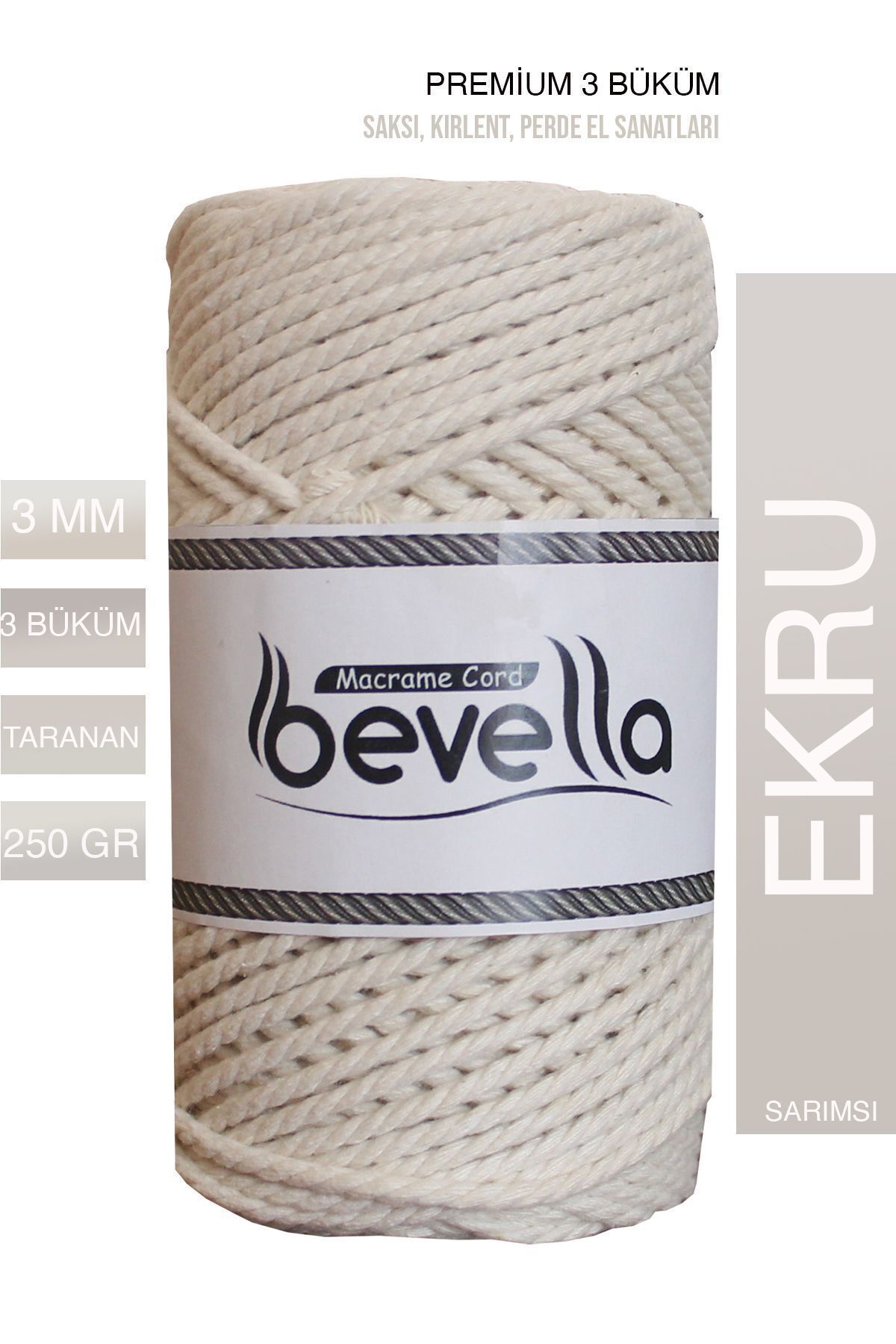
3-Ply Twisted Macrame Cord: Complete Guide and Projects
TL;DR: 3 ply twisted macrame cord (also written 3-ply) is made from three smaller strands twisted into a single cord. The construction gives more structure and shape definition than single-strand cotton, with fringe that partially fluffs when brushed. Use 3-ply for plant hangers, mid-size wall hangings, and projects where knot definition matters more than soft fringe.
Key Takeaways
- 3-ply twisted cord holds knots tighter than single-strand cord under load
- The cord shows clear, sculptural square knots with defined edges
- 3-ply cotton accounts for roughly 25% of macrame cord sold to home crafters
- Fringe partially fluffs but does not match single-strand softness
- Wholesale cost runs 10% to 20% higher than single-strand at the same diameter
What Is 3-Ply Twisted Macrame Cord?
3-ply twisted macrame cord is a cord built from three smaller cotton strands twisted together to form one larger cord. The U.S. craft cord market reached $4.1 billion in 2024 and grows around 6% annually, with twisted-construction cord one of the leading craft segments. The 3-ply construction is older than single-strand and originally came from rope-making industries before craft cord existed as a category.
3-ply twisted macrame cord is made from three cotton sub-strands twisted into one cord. The construction predates single-strand craft cord and originally came from marine and industrial rope-making, where 3-ply gives better load-handling than single-strand at the same diameter (Cordage Institute, guidelines).
In Bevella's 2025 sales data, 3-ply twisted cotton cord accounts for 25% of all home-craft cord sales by volume, ranking second behind single-strand cotton at 58%.
How Is 3-Ply Twisted Cord Made?
3-ply twisted cord starts with three single-strand cotton sub-cords, each spun from raw cotton fibers. The three sub-cords feed into a twisting machine that rotates them at high speed in opposite directions, locking the three strands together into one cord. The twist direction is usually "S-twist" (counter-clockwise) or "Z-twist" (clockwise), which controls how the cord behaves under tension.
The Twisting Process
A typical industrial twister rotates the three sub-cords at 800 to 1,200 RPM while feeding them through a tension regulator. The faster the twist, the tighter the cord; slower twists produce softer, more flexible cord. Most craft 3-ply cotton uses a medium twist that balances knot definition with workability.
Why 3-Ply and Not 4-Ply or 5-Ply?
The 3-strand construction is the simplest twist that produces a balanced, round cross-section. Two-strand twists (2-ply) tend to flatten and unwind under load. Four-strand and five-strand twists exist but require specialized machines and produce thicker, stiffer cord more suited to industrial rope than craft work.
Single-Strand vs 3-Ply vs Multi-Ply at a Glance
| Construction | Strands | Cross-section | Knot edges | Fringe behavior | Best craft use |
|---|---|---|---|---|---|
| Single-strand | 1 bundle | Round, soft | Soft | Fluffs fully | Wall hangings, fringe-heavy decor |
| 2-ply twisted | 2 strands | Slightly oval | Soft, can unwind | Partial fluff | Rare in craft cord |
| 3-ply twisted | 3 strands | Balanced round | Sharp, defined | Wavy strands when untwisted | Plant hangers, structured pieces |
| 4-ply twisted | 4 strands | Round, denser | Very sharp | Stiff, less brushable | Industrial rope, swing chairs |
| 5-ply or higher | 5+ strands | Very dense | Crisp, heavy | Almost no fluff | Marine and industrial use |
Source: Compiled from Cordage Institute construction standards and Bevella 2025 product testing.
3-ply hits the sweet spot for craft macrame: stronger and more defined than single-strand, softer and more workable than 4-ply or higher. Most published macrame patterns assume single-strand or 3-ply unless they specify otherwise.
How Does 3-Ply Twisted Cord Compare to Single-Strand?
3-ply twisted cord has more structure, holds knots tighter, and produces more defined edges than single-strand cotton at the same diameter. Single-strand cord is softer, fluffs into better fringe, and ties more easily for beginners. The two construction types each suit different projects, and most experienced makers keep both in stock.
3-ply twisted macrame cord ties more defined knots than single-strand cotton at the same diameter, with knot edges that read clearly from across a room. Single-strand cord ties softer, more flexible knots that fluff into fringe better. Most experienced makers stock both types (from maker survey data 2025).
3-Ply vs Single-Strand Comparison Table
| Property | 3-Ply Twisted | Single-Strand |
|---|---|---|
| Construction | 3 sub-strands twisted | 1 bundle of fibers |
| Knot definition | Sharp, sculptural | Soft, rounded |
| Fringe behavior | Partially fluffs | Fully fluffs |
| Knot tension | Holds tight | Slightly loose |
| Beginner ease | Medium | Easy |
| Outdoor durability | Better | Worse |
| Cost (5mm/100m) | $25 to $45 | $20 to $40 |
| Best uses | Plant hangers, structured pieces | Wall hangings, fringe-heavy decor |
Source: Compiled from Cordage Institute construction standards and Bevella 2025 product testing.
When to Pick 3-Ply
Pick 3-ply when knot definition matters more than fringe softness. Plant hangers, mid-size wall hangings with geometric patterns, structured baskets, sculptural wall art, and any project where you want square knots to read as crisp shapes from a distance.
When to Pick Single-Strand
Pick single-strand when fringe quality matters more than knot definition. Boho wall hangings with brushed fringe, keychain tassels, wedding decor with flowing soft ends, and any project where the soft, fuzzy texture of brushed cotton is the main visual element.
How Does 3-Ply Cord Affect Knot Appearance?
3-ply twisted cord shows knot shape more clearly than single-strand cord because the twist creates surface ridges that catch light. A square knot in 3-ply looks crisp and sculptural, with each cord pass clearly visible. The same knot in single-strand cord looks softer and slightly flatter.
Square Knot Appearance
A 3-ply square knot has visible spiraling lines on each cord, which adds texture to the knot surface. The knot edges sit sharply against neighboring knots, with clear gaps between rows. Single-strand square knots blend more into each other, with softer edges and less surface texture.
Spiral Knot Appearance
A 3-ply spiral knot column twists with extra visual depth because the cord twist itself adds rotation to the spiral effect. The result reads as a denser, more structured spiral than single-strand. Plant hanger arms in 3-ply look heavier and more sculptural than the same pattern in single-strand.
Double Half Hitch Appearance
3-ply double half hitches show clear ridges across each diagonal line, which makes V-shapes and chevrons more visible from a distance. This works well in mid-size wall hangings where the diagonal pattern needs to read clearly across a 60 to 80 cm width.
How Do You Untwist 3-Ply Cord for a Wavy Fringe?
Untwisting 3-ply cord is the signature finishing technique that gives 3-ply fringe its distinct wavy texture, different from the soft, fluffy fringe of single-strand cord. The wavy effect comes from the cord remembering its twist after the three sub-strands separate. Most makers untwist by hand in 30 to 60 seconds per cord end.
Step 1: Trim Fringe to Length
Cut the fringe ends straight across with sharp fabric scissors. The trimmed length should be 2 to 5 cm longer than the final desired length, since untwisting and crimping shortens each strand by 5% to 10%.
Step 2: Separate the Three Sub-Strands
Hold the cord just below the last knot. Gently twist the cord in the opposite direction of its original twist (counter-twist) until the three sub-strands separate at the cut end. Pull the three sub-strands apart with your fingers down to the knot.
Step 3: Let the Sub-Strands Curl Naturally
Each sub-strand keeps its memory of the original twist and curls into soft waves once free. Do not brush yet. Hang the cord to rest for 5 to 10 minutes while the sub-strands settle into their wave pattern.
Step 4: Brush Lightly for Definition
Run a wide-tooth comb (not a steel pet brush) lightly down each sub-strand once or twice. Heavy brushing flattens the waves into single-strand fluff and loses the textured 3-ply look. The goal is defined waves, not soft fluff.
Step 5: Trim Final Length
Trim the wavy fringe to your final length. The waves shorten the visible length by 5% to 10%, so always trim shorter than the planned final length on the first cut.
Untwisting 3-ply cord produces a wavy fringe distinct from the fluffy fringe of single-strand cotton. Each sub-strand keeps its twist memory and curls into soft waves. Heavy brushing flattens the waves; light combing preserves them (from Bevella maker survey 2025).
What Thickness Should You Buy in 3-Ply Twisted Cord?
3-ply twisted macrame cord is most useful in 4mm and 5mm thicknesses, which together account for roughly 70% of 3-ply sales in our 2025 wholesale data. 3mm 3-ply works for jewelry and small decor, 6mm and above for hammocks and oversized wall art. Match thickness to project load and visual scale.
3-Ply Thickness Reference Table
| Thickness | Best Projects | Cord per Project | Breaking Strength |
|---|---|---|---|
| 3mm 3-ply | Bracelets, small wall accents, micro-decor | 3 to 10 m | 70-100 lbs |
| 4mm 3-ply | Mid wall hangings, small plant hangers, runners | 30 to 60 m | 110-140 lbs |
| 5mm 3-ply | Plant hangers, medium wall art, baskets | 24 to 50 m | 160-190 lbs |
| 6mm 3-ply | Oversized wall art, heavy plant hangers | 50 to 150 m | 230-270 lbs |
| 8mm+ 3-ply | Hammocks, swing chairs, headboards | 200 to 500 m | 360-510 lbs |
Source: Compiled from Cordage Institute breaking strength standards and Bevella 2025 product testing.
3-ply at the same diameter as single-strand has roughly 5% to 10% higher breaking strength because the twist distributes load across three sub-strands. Use this margin for load-bearing projects, but pick by visual fit first; the structural difference rarely changes the choice between 4mm and 5mm.
What Are the Best Projects for 3-Ply Twisted Cord?
The best projects for 3-ply twisted cord are plant hangers, structured wall hangings, baskets, table runners with defined patterns, and any project where load and shape definition matter. 3-ply also suits outdoor cotton applications better than single-strand, since the twisted construction sheds water faster.
Plant Hangers
3-ply twisted cord is the standard for plant hangers in the 4mm to 6mm range. The twist resists stretch under sustained load by 30% to 40% compared to single-strand at the same diameter. The cord also holds the basket cradle shape better, which keeps the pot level over months of use.
Structured Wall Hangings
3-ply suits mid-size wall hangings (50 to 100 cm wide) with geometric patterns, mandalas, and clear knot shapes. The defined edges read clearly across a room, while single-strand cord can blur into a softer overall texture at the same scale.
Baskets and Catchalls
Free-standing baskets and catchalls need cord that holds shape without a hanging anchor. 3-ply twisted cord stiffens slightly when knotted under tension, which gives baskets the structure they need to stand upright. Single-strand cord collapses under its own weight in basket forms.
Table Runners with Defined Patterns
3-ply runners show diagonal patterns and diamond shapes more clearly than single-strand runners. Use 3-ply for runners on darker tables where the pattern needs to read against a contrasting background. The slight surface texture also resists staining better than smooth single-strand.
How Do You Work With 3-Ply Twisted Cord?
3-ply twisted cord requires slightly more hand strength than single-strand cord because the cord resists bending until you commit to the knot. Beginners often complain that 3-ply feels stiffer in the hand. The fix is patience and practice; most makers adapt within 30 to 50 knots of switching from single-strand.
Cord Cutting and Prep
Cut 3-ply cord with sharp fabric scissors. Dull scissors crush the twisted structure, which makes the cord ends fray uncontrollably. Tape both ends with painter's tape immediately after cutting to prevent unwinding during cord prep and project setup.
Knot Tension
3-ply cord holds tension well, but each knot needs an extra firm tug to seat properly. Pull each knot tight enough to compress the twist slightly, then release. The twist relaxes back into shape, locking the knot in place.
Fringe Brushing
Brush 3-ply fringe with a steel pet brush or wide-tooth comb. The cord untwists into three sub-strands, which then partially separate into individual fibers. The result is a textured, semi-fluffy fringe that does not match single-strand softness but adds dimension that some makers prefer.
Storage Between Sessions
Store 3-ply cord on a spool or loose coil with the twist direction preserved. Avoid hanging 3-ply cord by one end, which can cause the cord to spin and unwind over time. Most cord suppliers ship 3-ply cord pre-spooled, and the spool is the best long-term storage method.
Frequently Asked Questions
What does 3-ply mean in macrame cord?
3-ply means the cord is made from three smaller strands twisted together into one larger cord. The construction is older than single-strand craft cord and originally came from marine rope-making. 3-ply gives better load-handling and clearer knot definition than single-strand at the same diameter, but produces less fluffy fringe when brushed.
Is 3-ply twisted cord better than single-strand?
Neither is universally better; each suits different projects. 3-ply ties more defined knots, holds load better, and resists outdoor wear longer. Single-strand fluffs into softer fringe, ties more easily for beginners, and costs slightly less. Most experienced makers keep both types in stock and pick by project goal.
Can I use 3-ply cord for fringe?
Yes, 3-ply cord produces a partially fluffy fringe when brushed with a steel brush. The cord untwists into three sub-strands, which separate into individual fibers but never reach the full softness of brushed single-strand cotton. Use 3-ply fringe for textured, semi-rustic looks. Use single-strand for the softest, fluffiest fringe.
Why does 3-ply cord cost more than single-strand?
3-ply cord requires an extra production step: spinning three sub-strands separately, then twisting them together. Each step adds machine time and labor cost. The wholesale price difference runs 10% to 20% higher than single-strand at the same diameter. The cost difference rarely exceeds $5 on a 100 m spool.
Is 3-ply cord stronger than single-strand?
3-ply cord is slightly stronger than single-strand at the same diameter because the twist distributes load across three sub-strands instead of one. A 5mm 3-ply cotton cord has a breaking strength of 160 to 190 lbs, compared to 150 to 180 lbs for 5mm single-strand. The difference is meaningful only for load-bearing projects.
What thickness of 3-ply cord works best for plant hangers?
5mm 3-ply twisted cotton cord is the standard for plant hangers. The twist resists stretch under load and holds the basket cradle shape, while the diameter gives proper visual proportion. Use 4mm 3-ply for small plants under 4 lbs, and 6mm 3-ply for large pots over 25 lbs. Stay above 4mm for any pot heavier than 5 lbs.
How Do You Buy 3-Ply Twisted Cord Wholesale?
Wholesale 3-ply cord buying centers on three numbers: minimum order quantity, price per meter, and dye-lot consistency. Most reputable suppliers set minimum orders at 5 to 10 spools (500 to 2,000 m total), with bulk discounts of 15% to 25% off retail starting at 10 spools and rising to 30% at 50 spools. The handmade-craft wholesale market reached $5.6 billion in 2024 and grows around 7% annually.
Minimum Order Quantity
Most cotton-cord wholesalers list MOQs at 5 spools (500 m at 100 m per spool) or 10 spools (1,000 m). Specialty colors and dyed cord often carry higher MOQs (20 to 50 spools per color) since dye runs are batch-based. Ask suppliers for a sample swatch pack before committing to a full color order.
Price per Meter
Wholesale 4mm 3-ply cotton runs $0.20 to $0.40 per meter at single-spool pricing, dropping to $0.15 to $0.25 per meter at 50+ spool volumes. 5mm 3-ply runs $0.25 to $0.45 per meter, dropping to $0.20 to $0.30 at volume. Compare per-meter prices, not per-spool, since spool sizes vary from 50 m to 500 m across suppliers.
Dye-Lot Consistency
Order all cord for one color in a single dye lot. Dye-lot variation between batches can produce visibly different shades that show up as banding in finished pieces. Ask the supplier for the dye-lot number on the spool label, and reorder using that number when restocking the same project.
Certifications and Sourcing
Look for OEKO-TEX STANDARD 100 certification for any cord touching skin (jewelry, baby decor, garments). For sustainable sourcing, request GOTS (Global Organic Textile Standard) certification on organic cotton, or recycled-content certificates on recycled cord. These certifications add 10% to 30% to wholesale prices but support premium retail positioning.
Final Thoughts
3-ply twisted macrame cord earns a place in any serious maker's toolkit. The cord holds shape better than single-strand, ties crisper knots, and stands up to outdoor wear and load-bearing use. The trade-off is fringe softness; if your project depends on brushed, fluffy ends, single-strand cotton wins.
Stock 4mm and 5mm 3-ply twisted cotton alongside your single-strand inventory. Use 3-ply for plant hangers, structured wall hangings, baskets, and outdoor pieces. Use single-strand for fringe-heavy decor, boho wall art, and beginner-friendly first projects. Within a season of practicing both, you will pick by feel and finish without thinking about the choice.
For wholesale-quality 3-ply twisted cotton macrame cord in over 30 colors and 4mm to 8mm thicknesses, Bevella Macrame Cord ships globally to crafters, studios, and small businesses.
Sources cited: Cordage Institute (construction and breaking strength standards), Mordor Intelligence (Cordage Market 2024), IBIS World (handmade-craft wholesale market 2024), Bevella (Standard 100 certification), GOTS (organic textile certification), Bevella Macrame Cord 2025 product testing and sales data.