Large Scale Macrame Installations: A Planning and Cord Guide for Commercial Projects
A large scale macrame installation is a different discipline from a 60 cm wall hanging. The cord quantities, structural loads, lead times, fire ratings and team logistics all change once a piece exceeds about 2 m in any dimension. This guide explains how to plan commercial pieces for hotels, restaurants and event spaces, including cord maths for 10 m widths, wholesale sourcing, and the team coordination that keeps a deadline on track.
Key Takeaways
- According to Grand View Research's Macrame Market Report 2024, the global macrame market was valued at 1.05 billion USD in 2023, with hospitality and commercial decor named as a key growth segment.
- Commercial installations typically use 6 mm to 20 mm cord and require 5 to 10 times the cord mass of a domestic wall hanging of the same visual ambition.
- Most public-space installations require fire-rated cord or post-treatment to meet local building codes, plus engineered hardware for any piece that hangs over occupied areas.
What counts as a large scale macrame installation?
A large scale installation is any macrame piece designed for a public, commercial or architectural setting where dimensions, structural load, regulatory approvals and project management all become serious factors. The threshold is not a strict number, but most studios treat anything over roughly 2 m in width, 3 m in drop, or installed in a building where the public will sit or pass under the work as a commercial-scale project.
Common commercial settings
Hotels commission lobby pieces, headboards in feature suites, restaurant ceiling installations, spa relaxation walls, and event venue backdrops. Restaurants use macrame for room dividers, lighting accents, and seasonal pop-ups. Event spaces often need short-life installations for weddings, brand launches and exhibitions, sometimes assembled and removed in a single week.
Why scale changes everything
At domestic scale, a maker can carry the cord, prototype on a single rod, and adjust patterns by eye. At commercial scale, the cord arrives by pallet, the workshop needs ceiling clearance, the installation requires lifting equipment, and any rework consumes days rather than hours. Planning has to lead before fingers touch cord.
Cord quantity calculation for installations 10 metres and wider
The cord calculation that works for a 60 cm wall hanging breaks down on commercial scale because small estimation errors multiply into hundreds of metres. A more disciplined approach uses sample panels and per-square-metre figures rather than per-strand maths.
Per square metre estimation
Build a representative test panel of one square metre using your planned cord, knot density and pattern. Weigh the cord that goes into that panel. Multiply by the total square metres of the planned installation, then add a 15 to 20 percent overage for tying off, edge finishes, sampling and replacement. For dense 6 mm 3-ply cotton work, expect roughly 1.5 to 3 kg of cord per finished square metre.
Worked example: 10 m wide hotel lobby piece
For a piece 10 m wide and 3 m tall in 6 mm 3-ply cotton at typical density of 2 kg per square metre, the working calculation is 10 m by 3 m by 2 kg, or 60 kg of cord. Add 20 percent overage and round up: order 75 kg, divided into manageable spool sizes the team can lift without injury.
Build a sampling stage into every quote
Charge the client for a sample panel as a billable line item. The sample answers cord quantity, knot density, finished weight, colour accuracy under the venue's lighting, and approval from the interior designer or property owner. A signed-off sample also protects you if the final piece is challenged on appearance.
Structural and safety considerations
Commercial macrame installations move beyond decorative cord into rigging, fire safety, and public liability. Load-bearing anchor points, fire ratings on the cord material, and venue insurance approvals are not optional on hospitality, retail, or event projects. Treat each of these as a separate workstream with its own sign-off, and document rigging method, fire certification, and weight calculations before install day. The sub-sections below cover anchor planning, fire compliance, and load-spreading.
Mounting and anchor points
Calculate finished weight, multiply by a safety factor of at least three, and confirm the anchor points with the building's structural engineer or facilities manager. A 60 kg installation should have anchor capacity rated for at least 180 kg per attachment, distributed across multiple fixings. Never rely on plasterboard fixings alone for any commercial piece.
Fire ratings and building codes
Many countries require textiles in commercial public spaces to meet fire resistance ratings. Cotton cord is naturally flammable, but you can specify cord that has been treated with a flame retardant finish, or post-treat with a certified spray such as those meeting the Class 1 rating under ASTM E84 in the United States or the Class B-s2,d0 rating under EN 13501-1 in Europe. Always confirm the specific code with the venue and keep test certificates on file.
Hardware specification
For large pieces, use rated industrial hardware: stainless steel turnbuckles, welded D-rings, marine-grade shackles, and timber dowels of certified species. List each piece of hardware on a bill of materials, including the working load limit, so the client and the property's engineer can sign off in writing.
When to choose 20 mm rope and ultra-heavy cord
Cord at 20 mm and above is more rope than cord, and it serves a specific aesthetic and structural role on large installations. Used well, it brings architectural weight to a space. Used carelessly, it dominates and becomes a hazard.
Aesthetic role
Heavy rope creates a low knot count per square metre, which pairs well with minimalist or industrial interiors. The visual rhythm comes from the rope itself rather than from intricate knot work. Pieces designed around 20 mm cord usually feature simple knots at large scale, framed by heavy timber or steel.
Structural role
Ultra-heavy cord can act as a load path in suspended installations, supporting the weight of finer cord layered around it. In ceiling installations, a 20 mm cotton or hemp core line can carry secondary cords without sagging over time, which protects the long-term shape of the work.
Sourcing notes
20 mm and larger cord is usually a special order rather than a stock item. Lead times can run four to eight weeks, so include this on the project timeline early. Confirm cord weight per metre with the supplier because the figure varies more at heavy gauges than at standard 5 to 6 mm.
Coordinating a team on a commercial project
A 30 square metre installation is rarely a one-person build. Successful studios assemble small teams of two to four makers, brief them clearly with a written pattern key and color call-outs, and run the project with construction-style discipline. Daily check-ins, sample panels for tension matching, and a single named lead for rigging decisions keep cord output consistent across multiple hands. The sub-sections below cover team sizing, brief documents, and the quality checks that prevent rework.
Roles to assign
Typical roles include a lead designer, a senior knotter who owns pattern accuracy, two or three junior knotters for volume, a finisher who handles fringes and edge work, and an installer who handles rigging on site. On larger projects, add a project manager to track cord deliveries, hardware, sample approvals and invoicing.
Studio workflow
Use a marked-up master pattern at full scale, taped to a wall or rolled out on a long table. Knot in numbered sections so multiple knotters can work in parallel without crossing pattern errors. Photograph and weigh each section as it finishes so you can match against the original sample panel.
Site installation
Site days run on a venue's clock, not yours. Visit before installation to confirm anchor points, ceiling height, lift access and protection requirements for floors and finishes. Bring redundant hardware, a basic toolkit, and a small reserve of matching cord for any last-minute repairs.
Wholesale cord sourcing for large projects
Sourcing cord for a 60 kg or 200 kg project changes the supplier conversation. You are no longer buying off the shelf, and the supplier needs to plan production around your delivery date.
Lead time planning
Quality wholesale suppliers typically need three to six weeks to spin, dye and ship a project of 50 kg or more in a single colour and batch, longer for special colours or certifications. Confirm lead times in writing before you commit to a venue install date.
Batch consistency
Order all cord for one installation in a single dye lot. Cotton cord shows visible colour shift between batches, which is invisible on a 1 m sample but obvious on a 10 m wall. If a single batch is impossible, ask the supplier to label spools by batch and design the piece so colour transitions land on natural pattern breaks.
Documentation to request
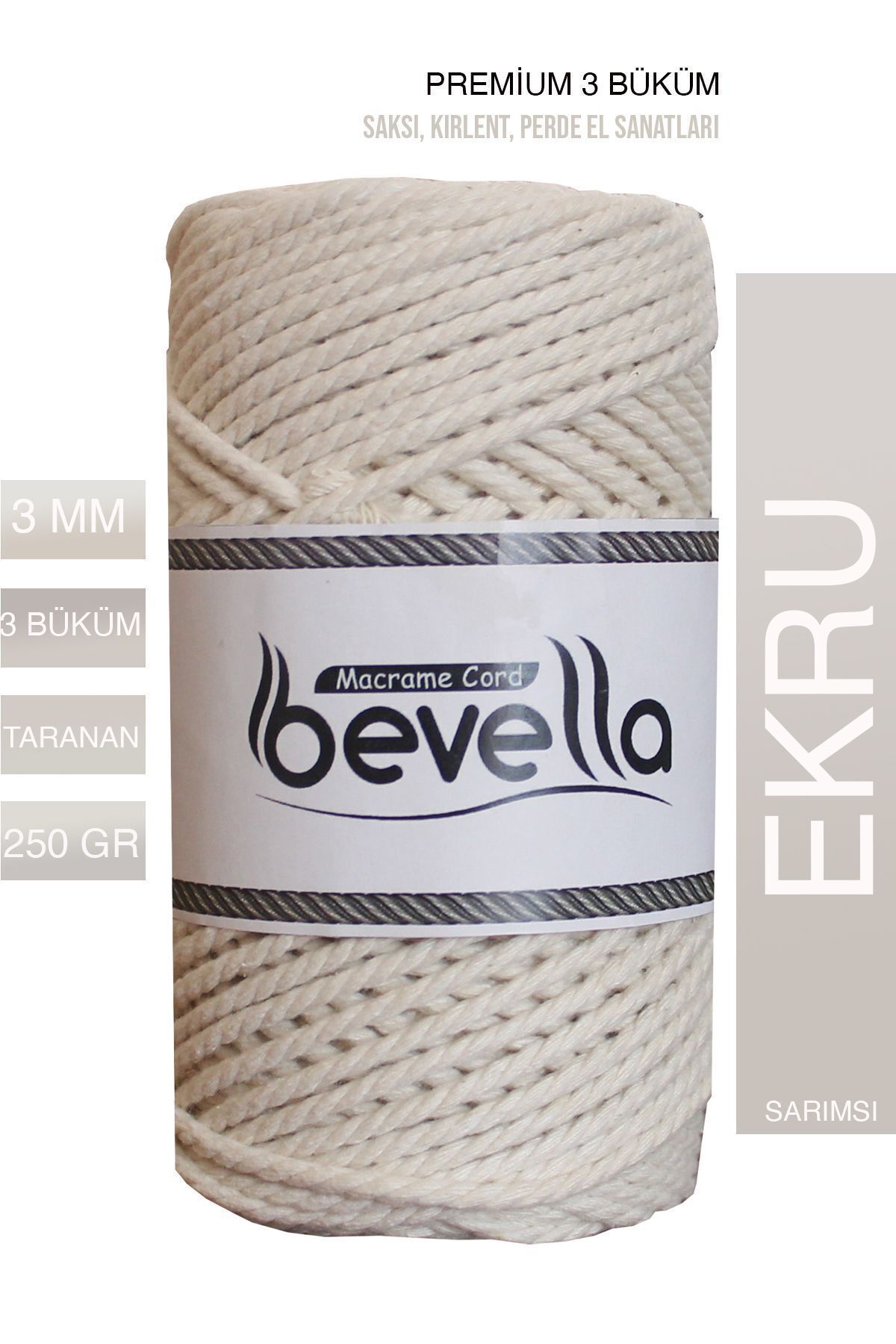
Request a commercial invoice, a colour swatch from the actual production batch, the grams per metre figure for that batch, the Bevella or GOTS certificate if applicable, and any fire test certificates if you ordered treated cord. Keep these in the project folder for later handover to the client.
Frequently Asked Questions About Large Scale Macrame Installations
How long does a 10 m commercial installation take to make?
Typical timelines run 8 to 16 weeks from signed brief to install, including sampling, cord delivery, knotting, finishing, transport and on-site rigging. Knotting itself for a 30 square metre piece often takes a small team three to five weeks. Always quote longer than you think you need so finishing details get proper attention.
Do I need insurance to take on commercial macrame work?
Yes. Public liability insurance covering installation work is the minimum, and many venues will require a certificate of insurance before approving access. Add product liability cover for the finished piece and consider professional indemnity if you sign off structural calculations yourself.
Can macrame survive in a humid environment such as a spa or pool area?
Cotton cord absorbs moisture and can mildew in continuously humid spaces. For spas, pool areas and outdoor covered settings, specify polypropylene, polyester or treated synthetic cord rather than cotton. Bevella and similar suppliers offer synthetic ranges in colours that mimic natural cotton for these settings.
How do I price a commercial installation?
Build a quote from cord cost, sampling cost, design hours, knotting hours at a fair studio rate, finishing hours, hardware, transport, install crew time and a contingency of 10 to 15 percent. Add margin on top, not inside, the cost lines so you can negotiate without losing visibility of your true costs.
What is the largest single piece a workshop can produce?
There is no fixed maximum, but practical limits sit around 12 m by 5 m before transport and access become major obstacles. Beyond that, design the piece in panels that interlock or hang side-by-side on site. Modular panels also let you replace a single section if it is damaged, which extends the working life of the installation.
A large scale macrame installation succeeds when planning leads, sampling proves the design before production, and the team installs against a clear, documented brief. Treat each project as a small construction job that happens to be made of cord, and the cord itself becomes the easy part. Build relationships with one or two reliable wholesale cord suppliers, collect the certificates and test data you will need for repeat commissions, and your studio becomes a serious option for the next architect or hotel group looking for textile artistry at scale.
Sources cited: Grand View Research Macrame Market Report 2024, ASTM E84 fire test standard, EN 13501-1 European fire classification standard.