Macrame Lamp Shade Guide: Cord Choice, Frames, Heat Safety
A handmade macrame lamp shade reads as warm, textural, and far more interesting than a factory drum shade. The lamp shades market reached USD 35.58 billion in 2025 ([Coherent Market Insights](https://www.coherentmarketinsights.com/industry-reports/lamp-shades-market), 2025), and table shades alone hold 35.2% of that share. Yet most maker tutorials skip heat clearance, the one rule that decides whether a piece is a beautiful lamp or a fire hazard. This guide covers cord, frames, sizing, patterns, and LED safety so the shade looks right and stays safe.
Key Takeaways
The lamp shades market reached USD 35.58 billion in 2025 ([Coherent Market Insights](https://www.coherentmarketinsights.com/industry-reports/lamp-shades-market), 2025), with table shades at 35.2% of share.
For 40-60W incandescent bulbs, leave 1-2 inches between bulb and shade; for 75-100W, leave 2-3 inches ([LampsUSA Lighting Guide](https://www.lampsusa.com/blogs/lighting-guides/lamp-shades-light-bulb-heat-and-lamp-electrical-safety-tips), 2024).
NEC 410.97 caps combustible material temperature near a fixture at 90°C (194°F) ([NEC Code Brief](https://www.ecmweb.com/national-electrical-code/code-basics/article/20897204/nec-rules-for-installing-lighting-on-circuits-greater-than-30v), 2024).
LED bulbs (8-10W draw, 60W equivalent) run at 35-50°C, well within safety limits.
The residential lamp shade segment holds 66.2% of market share ([Future Market Insights](https://www.futuremarketinsights.com/reports/lamp-shades-market), 2025).
Why does a macrame lamp shade need different cord than wall hangings?
Lamp shades sit close to a heat source, so cord choice matters in ways that decorative wall pieces never face. Cotton chars rather than melts under heat, while polyester melts at 250-260°C and can drip if a bulb fails. Natural fibers (cotton, linen, hemp) are the safe baseline for any project that wraps or surrounds a bulb. The cord must also be open enough to let warm air rise out the top of the shade, because trapped heat builds up faster than most makers expect.
Char vs melt at fire temperatures
Cotton, linen, and hemp char rather than melt when temperatures exceed 200°C. Charring takes longer to ignite and gives off less toxic smoke than melted plastic. Polyester and nylon both soften and drip at 230-260°C, which can ignite paper, dust, or accumulated lint nearby. Even with safe LED bulbs, natural fibers add a margin if a renter or guest swaps in a higher-watt bulb.
Knot density vs heat dissipation
Tight knot patterns trap heat. Open patterns let air flow through. For shades within 2-3 inches of a bulb, choose open patterns such as basic square knot diamonds, lark's head meshes, or alternating square knot grids. Save dense patterns (full square knot fields, tight overhand grids) for shades that sit 4+ inches from any bulb surface.
Cord thickness for lamp shades
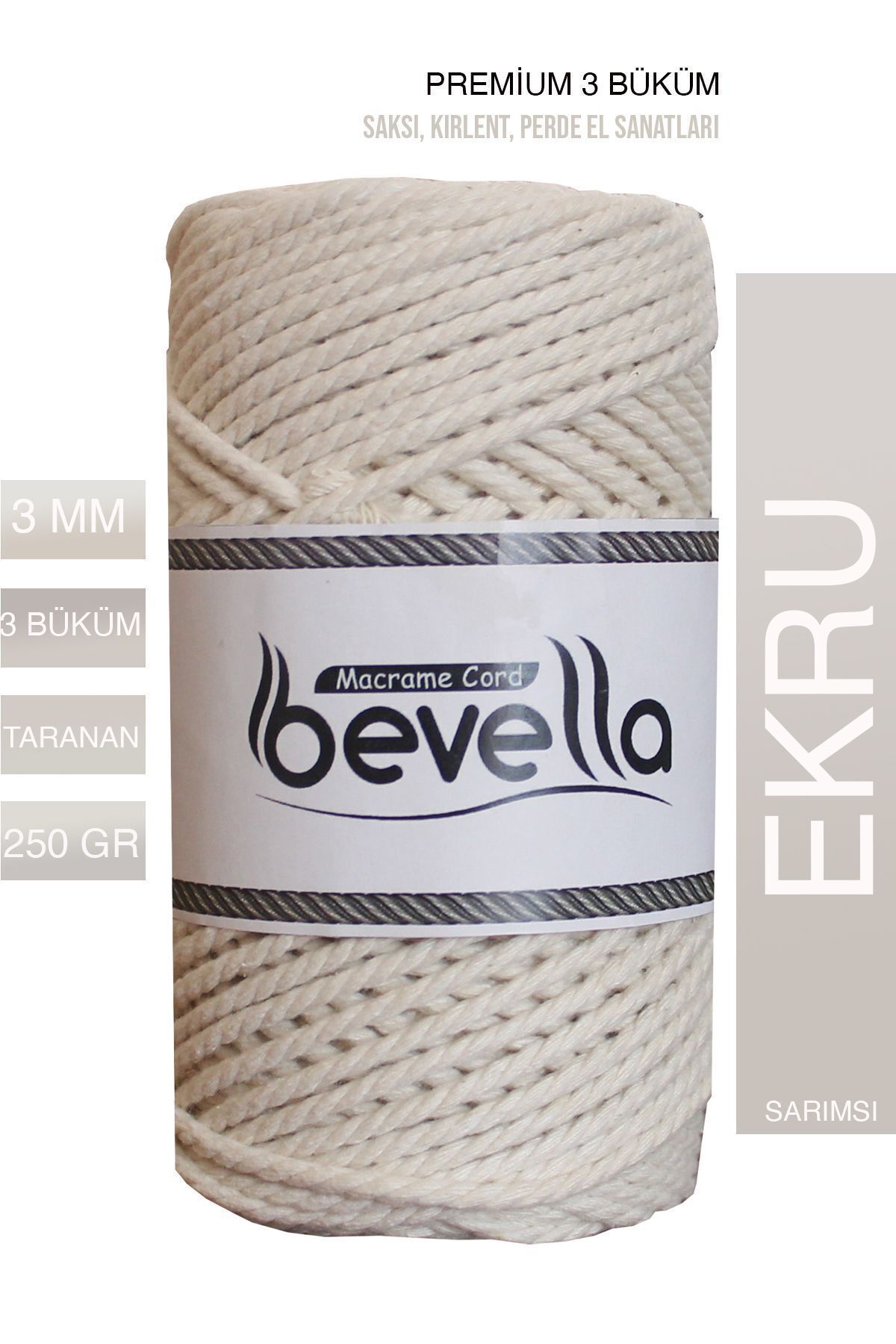
Most macrame lamp shades use 3-4mm cotton 3-strand or single-twist cord. Thinner cord (2mm) suits small accent shades on micro lamps or jewelry-scale pendants. Thicker cord (5-6mm) suits floor lamps where the shade is large enough to stay 4+ inches from the bulb. Single-twist cord brushes into soft fluff at the bottom edge; braided cord holds knot detail more crisply.
(https://www.lampsusa.com/blogs/lighting-guides/lamp-shades-light-bulb-heat-and-lamp-electrical-safety-tips), 2024). LED bulbs run cool enough that this rule is the maximum, not the minimum, for safe macrame shade design.]
What cord types are safe for lamp shade projects?
Cotton 3-strand, single-twist cotton, linen, and hemp are the four safe cord types for lamp shades. Polyester and nylon are not recommended for any shade project even with LED bulbs because they offer no margin if the bulb is later swapped. Sparkle and metallic cords contain plastic films that can soften under heat. The table below compares the four safe cords by knot definition, heat tolerance, and best use.
Lamp shade cord comparison
| Cord | Char temperature | Knot definition | Best shade type | Cost (per 100m, 4mm) |
|---|---|---|---|---|
| Cotton 3-strand | Above 200°C | Excellent | Pendant, table, floor | $7-12 wholesale |
| Single-twist cotton | Above 200°C | Good, brushable | Floor, statement pendant | $7-12 wholesale |
| Linen | Above 230°C | Very good, stiff | Modern minimal pendant | $14-22 wholesale |
| Hemp | Above 200°C | Good, slightly coarse | Rustic farmhouse shade | $11-16 wholesale |
When cotton 3-strand wins
Cotton 3-strand is the default for most lamp shade projects. The twist holds knot patterns crisp, the fiber chars rather than melts, and the cord drapes well around frames. It also handles the slight stretching that happens when warm air cycles through the shade over months. Choose 4mm for medium pendants, 5mm for floor lamps, 3mm for small table accent shades.
When linen earns the premium price
Linen costs roughly twice cotton but reads as more refined. Modern minimal pendants and design-led table shades benefit from the slightly stiff drape and the natural ivory tone. Linen also has a higher char temperature, which gives an extra margin on shades that sit closer to bulbs.
Materials to avoid for shades
- Polyester macrame cord: melts at 250-260°C, drips when ignited
- Nylon paracord: similar melt behavior, releases harsh fumes when burned
- Sparkle/lurex cord: metallic film softens at 90-100°C
- Acrylic blends: melt before burning, not safe near bulbs
- Synthetic raffia: melts and shrinks under heat
What frame types work for macrame lamp shades?
Wire ring frames, bamboo or wooden hoop frames, existing drum shades, and custom welded frames are the four main options for macrame lamp shades. Each suits different lamp types and skill levels. Wire rings are easiest for pendants, hoops add visible warmth for boho styles, recycled drum shades give stable structure for table lamps, and welded frames serve floor lamps that need rigid 360-degree support.
Wire ring frames
Single steel wire rings, sold in 15-60 cm diameters, anchor most pendant macrame shades. Mount cord with lark's head knots around the ring, then knot downward. The ring sits inside the shade at the top, hidden by knots. Powder-coated rings suit white shades; brass-finish rings warm up natural cotton.
Bamboo and wooden hoops
Embroidery hoops or bamboo rings make decorative frames where the wood shows as part of the design. They suit boho and farmhouse pendants. Choose hoops 1-2 cm thick for stability under cord tension. Wood absorbs less heat than metal and may need slightly larger bulb-to-shade clearance, around 18-20 cm minimum for LED globe bulbs.
Existing drum shades as a base
Recycling an existing fabric drum shade gives instant structure. Strip the fabric off the wire frame, then weave macrame cord through the top and bottom rings. This method works well for table lamps because the original fabric drum was already sized to the harp and bulb. It also recycles a piece that would otherwise go to landfill.
Custom welded frames
For floor lamps or pendants larger than 60 cm diameter, custom welded steel frames hold shape under heavier cord weight. A fabricator can build to spec for $50-150 depending on size. The frame includes a fitting hardware ring at the top sized to standard lamp bases, which simplifies installation later.
[CHART: Donut chart - lamp shade frame popularity in macrame projects: Wire ring 50%, Bamboo hoop 25%, Recycled drum 18%, Custom welded 7% - source: Bevella wholesale data, 2025]
How do you size a macrame lamp shade?
Size a macrame lamp shade to match the lamp base or pendant chain, not just the room. The classic rule: shade height should be one-third the total lamp height for table lamps, and shade diameter should equal twice the base diameter. Pendant shades scale to the room area: roughly 30-40 cm diameter for small rooms, 45-55 cm for medium, and 60+ cm for high ceilings or open-plan spaces. Floor lamp shades run 35-50 cm diameter regardless of room size.
Table lamp shade sizing
- Small table lamp: 25-30 cm shade diameter, 18-22 cm shade height, fits a 12 cm base
- Medium table lamp: 35-40 cm shade diameter, 25-30 cm shade height, fits a 15-18 cm base
- Large table lamp: 45-50 cm shade diameter, 30-35 cm shade height, fits a 20+ cm base
- Pair lamp rule: when sizing a pair, match exactly because mismatched shades read as accidental
Floor lamp shade sizing
- Floor lamp shades run 35-50 cm diameter and 30-45 cm height for traditional shapes
- Drum-shape macrame floor shades work at 40 cm diameter, 30 cm tall
- Pendant-style floor lamps (extended arm) use shades sized like ceiling pendants
- The shade should sit between eye level (when standing) and chin level (when seated)
Pendant lamp shade sizing
Pendant size scales with the surface or room below. Over a 1.5 meter dining table, a single 50 cm pendant works. Over a 2 meter island, three 30-35 cm pendants spaced 60 cm apart. In an entryway or stairwell, sized to the room area: roughly 1 cm of pendant diameter per 2-3 square meters of room area.
Cord length calculation for shades
Cord usage runs 4-5 times the finished shade height for medium-density patterns and 6-7 times for full coverage. A 30 cm tall shade uses 120-150 cm per strand for standard density. Multiply by strand count, then add 15% buffer. For a 30 cm pendant shade with 24 strands and standard density, plan 30-35 meters total cord.
Which knot patterns work best for lamp shades?
Open knot patterns work best for lamp shades because they let warm air rise out and cast soft shadow patterns on walls. Square knot diamonds, alternating square knot grids, lark's head meshes, and double half hitch chevrons all create attractive light diffusion. Solid coverage patterns trap heat and block too much light. The four pattern categories below cover most lamp shade projects from minimal modern to full bohemian.
Open patterns for light diffusion
- Square knot diamond: alternating knot positions create diamond gaps; classic boho look that throws diamond shadow patterns on walls
- Lark's head mesh: simplest open pattern, fast to make, suits beginner shades
- Switched square knot: pairs alternate working strands, creating a grid with regular gaps
- Open half hitch chevron: angled knot rows form V or zigzag patterns with visible gaps between rows
Medium-density patterns
- Alternating square knot grid: tighter than open patterns but still allows airflow
- Berry knot accent: small berry knots punctuate larger open fields
- Wave pattern: curved double half hitch rows create a flowing texture
Solid coverage patterns
Solid coverage patterns (close-packed square knots, full overhand grids) suit shades positioned 4+ inches from any bulb. They cast a softer overall glow rather than patterned shadows. Reserve these for floor lamps, pendant shades with extended chain length, or accent shades not meant to throw pattern light.
Pattern choice by lamp type
- Table lamp: medium-density alternating grids; readable from seating distance
- Floor lamp: open or medium-density patterns; viewer sees pattern from across the room
- Pendant: open patterns to cast wall shadows; choose pattern complexity to match room style
- Accent or task lamp: dense patterns acceptable because the lamp is small and bulb low-watt
How do LED and incandescent bulbs change the safety math?
LED bulbs change everything for macrame lamp shades. A 60W-equivalent LED draws 8-10 watts and runs at 35-50°C surface temperature. A 60W incandescent bulb runs at 200°C, well above NEC 410.97's 90°C combustible-safe limit ([NEC Code Brief](https://www.ecmweb.com/national-electrical-code/code-basics/article/20897204/nec-rules-for-installing-lighting-on-circuits-greater-than-30v), 2024). With LED bulbs, macrame shades can sit closer to the bulb than legacy guidelines suggest. With incandescent or halogen bulbs, fabric shades require larger clearance and may not be safe at all.
LED bulb advantages for macrame
- LED bulbs at 60W-equivalent (8-10W actual) run at 35-50°C surface
- LED bulbs at 100W-equivalent (12-14W actual) run at 50-65°C
- These temperatures are well below the 90°C NEC combustible material limit
- LED bulbs allow macrame shades to sit 5-8 cm from the bulb without heat buildup concerns
Incandescent and halogen issues
- 60W incandescent surface reaches 200°C (392°F)
- 60W halogen runs at 250°C (482°F)
- Both exceed NEC 410.97's 90°C combustible material limit
- Even cotton macrame can scorch within 30-60 minutes of contact at these temperatures
CFL bulb compatibility
Compact fluorescent bulbs sit between LED and incandescent for heat. A 60W-equivalent CFL runs at 60-80°C, still inside the 90°C limit but warmer than LED. CFL bulbs are also being phased out in many regions due to mercury content. LED is the recommended bulb for any macrame shade project sold or made in 2025 onward.
Smart bulb considerations
Smart LED bulbs add radio modules that can run 5-10°C warmer than basic LEDs at the base. The light-emitting surface stays similar, but the base near the socket gets warmer. For shades with cord tied close to the lamp socket, allow 1-2 cm extra clearance to the smart bulb base.
Always check the fixture rating
Every lamp socket has a maximum wattage rating printed on the socket or in the manual. Check this before installing any bulb. The wattage cap protects the wiring, not the shade. A shade may handle a 100W LED but the fixture may cap at 60W. Always use the lower of the two limits.
How do you install a macrame lamp shade safely?
Install a macrame lamp shade in five steps: confirm bulb type, measure clearance, mount the macrame on the frame, test before final use, and add a care card if selling. Most installs take 20-40 minutes after the macrame piece is finished. Hire a licensed electrician for any new wiring or non-standard fixtures. The macrame work is DIY-friendly; the wiring may not be.
Five-step installation checklist
- Step 1, bulb check: confirm an LED bulb is installed at the wattage cap or below; replace any incandescent or halogen bulb before fitting the shade
- Step 2, clearance measurement: measure from bulb surface to nearest macrame cord; confirm at least 5-8 cm for LED, more for any other bulb type
- Step 3, mount macrame: attach the macrame frame to the lamp via standard harp and finial for table lamps, chain or cord for pendants, or fitter ring for floor lamps
- Step 4, burn-in test: run the lamp for 30 minutes, then touch the cord nearest the bulb; it should feel warm at most, never hot
- Step 5, care card: for sold pieces, include a card stating LED-only, maximum wattage, and minimum 5 cm clearance
Hardware fittings for different lamp types
- Table lamp: spider fitter on top ring, supported by harp and finial; size to standard 7/8 inch (22 mm) harp
- Pendant: top ring sized to fit over the existing chain or cord; secure with S-hooks or jump rings
- Floor lamp: large fitter ring (UNO or spider) sized to the floor lamp's bulb cage
- Sconce: small clip-fitter that grips the bulb base directly; choose only if the bulb is LED with minimal heat
Long-term safety inspection
Inspect the shade every six months. Look for discoloration on cord nearest the bulb (signals heat exposure). Check for dust accumulation, which can smolder under heat over months. Replace any bulb that has been swapped to incandescent or halogen by a renter or guest. Vacuum the shade annually with a soft-brush attachment on lowest suction.
Frequently Asked Questions About Macrame Lamp Shade
Are macrame lamp shades safe?
Macrame lamp shades are safe when made with cotton, linen, or hemp cord and used with LED bulbs that stay below 90°C combustible-safe limit ([NEC Code Brief](https://www.ecmweb.com/national-electrical-code/code-basics/article/20897204/nec-rules-for-installing-lighting-on-circuits-greater-than-30v), 2024). Maintain 5-8 cm clearance for LED bulbs, more for any other bulb type. Polyester and nylon cords are not recommended because they can melt and drip if a bulb is later swapped for higher-watt.
Can I use any cotton cord for a lamp shade?
Most cotton macrame cord works for lamp shades, but choose 3-strand or single-twist cotton in 3-5 mm thickness. Avoid cotton that has been treated with flame retardants intended for upholstery, because the chemicals can release fumes when warm. Untreated natural cotton chars at 200°C+ and gives a comfortable safety margin with LED bulbs that run at 35-50°C.
What knot pattern works best for a pendant shade?
Open knot patterns work best for pendant shades because they cast attractive shadows and allow warm air to escape. Square knot diamonds, alternating square knot grids, and double half hitch chevrons all work well. Pendant shades sit closer to the eye than table lamps, so pattern detail matters more. Choose a pattern that reads clearly at the viewing distance for the room.
How do I clean a macrame lamp shade?
Vacuum a macrame lamp shade every 2-3 months on lowest suction with a soft brush attachment. For deep cleaning every 12 months, remove the shade, dust thoroughly, then mist with cool water and mild soap from a sprayer. Dab gently with a soft cloth, rinse with clean water mist, and air dry fully (24-48 hours) before reinstalling. Skip steam cleaners which can warp natural fibers.
Can I make a macrame lamp shade for an outdoor patio lamp?
Outdoor patio lamps need polyester cord for weather resistance, but polyester is not recommended for shades. Reserve macrame shades for indoor lamps. For outdoor lighting that needs a textile element, build a separate decorative cover that hangs alongside (not around) the bulb, so the cord never sits in the heat path. Use solution-dyed polyester or hemp for the decorative cover.
How long does a macrame lamp shade last?
A well-made cotton macrame lamp shade lasts 5-10 years indoors with proper care. Annual cleaning, six-month inspections, and LED-only bulb use prevent the heat damage and dust buildup that shorten life. The biggest risk to longevity is bulb swap by a guest or renter who installs an incandescent bulb. A clear care card and a permanent LED bulb installed before delivery prevent that risk.
A macrame lamp shade pairs handmade warmth with the soft glow of low-watt LED light. The technical rules are simple: cotton, linen, or hemp cord; LED bulbs only; 5-8 cm minimum clearance; open patterns for pendants and table lamps. With the planning, frame, sizing, and pattern choices above, the shade looks beautiful and stays well within fire code. The 66.2% residential share of the lamp shade market ([Future Market Insights](https://www.futuremarketinsights.com/reports/lamp-shades-market), 2025) is the audience that pays for handmade warmth, and a properly built macrame shade delivers it without compromise.
Sources cited: Coherent Market Insights Lamp Shades Market Report (2025), Future Market Insights Lamp Shades Market (2025), NEC 410.97 Code Brief (EC&M, 2024), LampsUSA Lighting Guide (2024), Bevella wholesale lamp shade project data (2025).