Macrame Jewelry Making Guide: Cord Specs, Knots and Beads
Macrame jewelry making turns thin waxed cord into bracelets, necklaces, earrings, and anklets at the millimeter scale where every knot reads. The global handmade jewelry market hit USD 157.5 billion in 2024 with projected 11.20% CAGR through 2033 according to Custom Market Insights, and bracelets specifically peaked in search volume in September 2025 for boho stackable styles. This guide covers cord specs from 0.5 to 2 mm, skin-safe material requirements, knot patterns, and clasp attachment methods.
Key Takeaways
- Global handmade jewelry market reached USD 157.5 billion in 2024 with 11.20% projected CAGR through 2033 per Custom Market Insights data.
- craft marketplaces captured roughly 15% of global handmade jewelry e-sales according to handmade jewelry market research, with jewelry up 16% on the platform in 2025.
- Micro-macrame uses cord between 0.5 and 1.5 mm; cord above 2 mm is rare in jewelry work because the knots become too bulky for wearable scale.
- Waxed cords (Linhasita, C-Lon, S-Lon) hold knots better than unwaxed because the wax adds friction and prevents slippage.
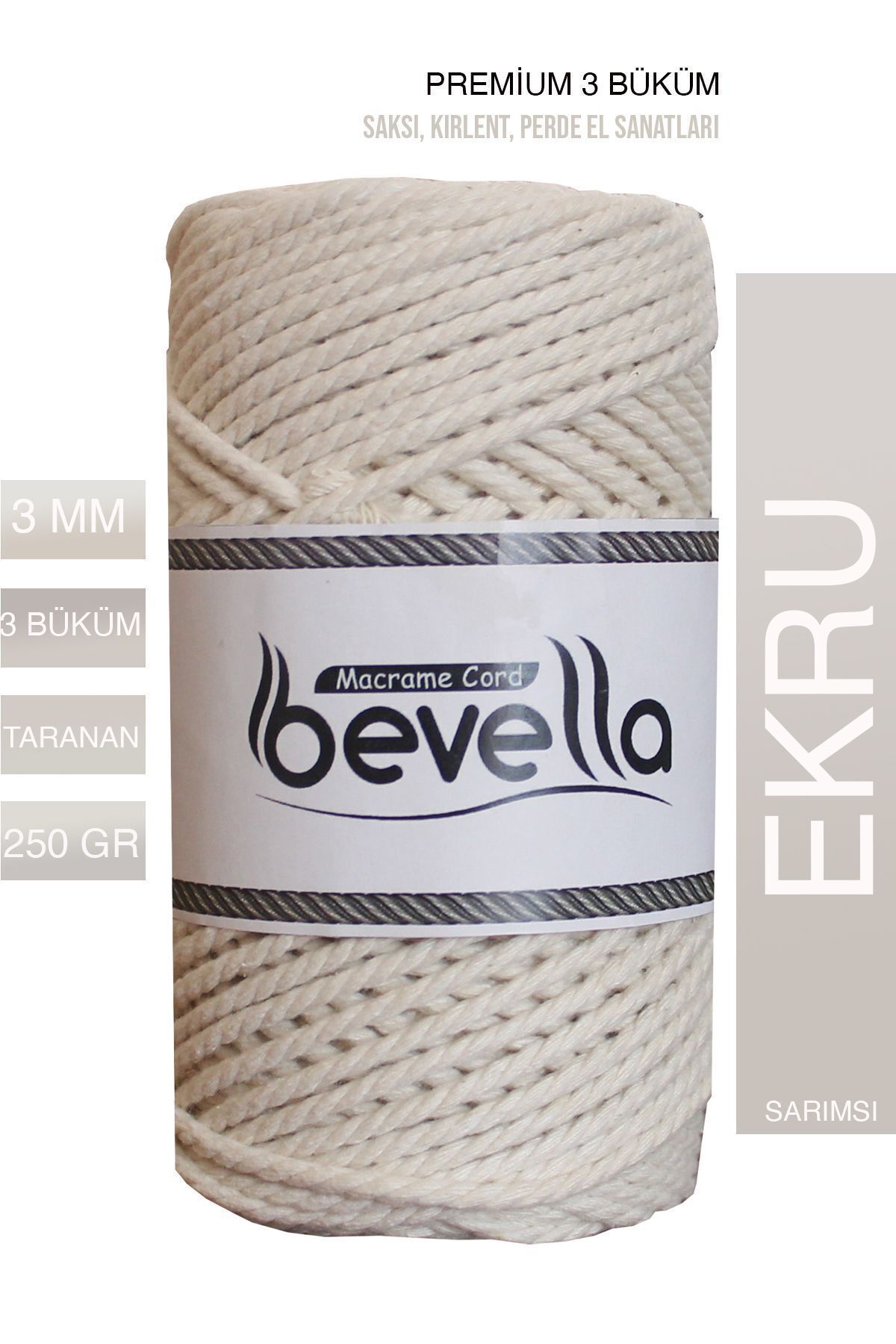
- Bevella's wholesale catalog focuses on macrame cord at 3 mm and up; for jewelry-scale work, partner with specialist micro-cord suppliers and combine with Bevella cord for hybrid statement pieces.
What Cord Specs Work Best for Macrame Jewelry?
Macrame jewelry uses cord between 0.5 mm and 2 mm in diameter, with 1 mm waxed polyester or waxed cotton as the standard for beginners. Cord diameter directly controls knot scale, finished bracelet thickness, and bead-hole compatibility. Smaller cord (0.5 to 0.75 mm) produces fine micro-macrame with crisp tiny knots; larger cord (1.5 to 2 mm) produces chunky statement pieces with visible texture.
The 1 mm beginner sweet spot exists because the knots are large enough to see clearly while learning, and most beads sold for jewelry making have hole diameters that pass 1 mm cord (or doubled 1 mm cord at 2 mm effective diameter). Smaller cord requires sharper vision and finer tweezers; larger cord limits which beads can be used because most beads have holes under 2.5 mm.
Waxed cords are the standard for jewelry because the wax coating adds friction. Knots tied in waxed cord hold position permanently after cinching; knots tied in unwaxed cord can slip back open under wear. Linhasita is the heavy reference standard for jewelry waxed cord, with Brazilian wax coating that grips knots aggressively. C-Lon and S-Lon are American alternatives, slightly less sticky than Linhasita but easier to thread through small bead holes.
| Cord Type | Diameter | Use Case | Knot Hold |
|---|---|---|---|
| C-Lon | 0.5 mm | Fine micro-macrame | Good with bead anchors |
| Linhasita waxed polyester | 0.75 mm | Tight micro-macrame | Excellent |
| Linhasita waxed polyester | 1 mm | Standard bracelets | Excellent |
| Waxed cotton | 1 mm | Boho bracelets, anklets | Good |
| S-Lon Tex 400 | 0.9 mm | Beaded jewelry, kumihimo | Very good |
| Waxed polyester | 1.5 mm | Chunky bracelets, necklaces | Excellent |
| Hemp twine | 1 to 2 mm | Rustic boho jewelry | Good |
| Chinese knotting cord | 0.8 to 2 mm | Decorative knots | Good |
Source: Perles & Co micro-macrame cord guide, Beadaholique macrame techniques.
What Are the Skin-Safe Material Requirements for Wearable Cord?
Wearable macrame cord should be free of nickel, formaldehyde, and AZO dye residues, with OEKO-TEX STANDARD 100 certification when available. Cord that touches skin all day can cause contact dermatitis from chemical residues, allergic reactions to certain dyes, and skin discoloration if dye bleeds in sweat. The certification chain matters more for jewelry than for decorative cord because exposure is constant.
The major skin sensitizers to avoid are AZO dyes (split into harmful aromatic amines through skin contact and bacterial action), nickel-containing metallic threads (a top contact allergen), and formaldehyde-based finishes (released as the cord weathers, causing irritation in sensitive skin). OEKO-TEX STANDARD 100 certification tests against all three categories at safe levels for human textile contact.
Hypoallergenic-grade cord is a smaller niche within jewelry cord. Some manufacturers specifically market jewelry cord as hypoallergenic with documentation of nickel-free finishes and AZO-free dyes; these cost more than standard waxed polyester but matter for makers selling to customers with sensitive skin or known nickel allergies. For commercial jewelry sales, hypoallergenic certification doubles as marketing differentiation and allergy liability protection.
Color and dye stability also affect skin contact. Cheaper dyed cords can bleed color into the wearer's skin during the first few wears, especially in dark colors (navy, black, deep red). Pre-washing the cord before knot work locks in remaining dye and prevents staining. Better-quality jewelry cord uses fiber-reactive dyes that bond chemically with the cotton or polyester rather than just coating the surface, which both stays on the cord and resists fading.
What Knot Patterns Work for Wearable Scale?
The core jewelry knot patterns are the square knot flat band, spiral half-hitch, lark's head sennit, Cavandoli weave, and the basic friendship bracelet diagonal knot (chevron pattern). These all work at wearable scale (5 to 25 mm finished width) and translate cleanly between cord diameters from 0.5 to 2 mm. More complex macrame knots (Berry knots, Crown knots, complex Chinese decorative knots) work in jewelry but demand more practice.
The square knot flat band is the most-used pattern in macrame jewelry. Two filler cords run through the center; two working cords tie alternating square knots around them. The result is a flat band 5 to 12 mm wide depending on the cord, with tight uniform knots that read as a clean texture. This is the foundation pattern for most beaded bracelets, friendship bracelets, and chunky statement bracelets.
Spiral half-hitch produces a twisted rope effect by tying the same half-hitch repeatedly with one working cord around a central core. The natural cord twist accumulates and the band rotates as you tie, creating a spiral. This pattern works well for thin necklaces, anklets, and decorative cord between bead clusters.
Cavandoli weave is the macrame technique for creating geometric patterns and lettering using two contrasting cord colors. Letters, geometric shapes, and pattern motifs are tied into the body of the band as the work progresses. Cavandoli takes longer to learn than square knot work but produces the most distinctive jewelry pieces because the patterns are unique to each piece.
| Pattern | Difficulty | Typical Width | Best For |
|---|---|---|---|
| Square knot flat band | Beginner | 5 to 12 mm | Bracelets, anklets |
| Spiral half-hitch | Beginner | 3 to 6 mm | Anklets, thin necklaces |
| Lark's head chain | Beginner | 4 to 8 mm | Bracelets with sliding clasp |
| Diagonal chevron (friendship) | Intermediate | 8 to 20 mm | Patterned bracelets |
| Cavandoli weave | Advanced | 10 to 25 mm | Geometric pattern bracelets |
| Berry knot accents | Intermediate | Variable | Decorative texture bands |
| Spiraled square knot | Intermediate | 5 to 10 mm | Twisted rope effect |
How Do You Add Beads and Charms to Macrame Jewelry?
Beads attach to macrame jewelry by threading them onto a filler cord or working cord between knots, with the knots locking the bead in place at the chosen position. Beads with holes that pass the cord cleanly (typically 2 to 4 mm hole diameter for 1 mm cord doubled, or 1 to 2 mm for single 1 mm cord) are the simplest. Larger feature beads with cord-channel holes can frame a bracelet centerpiece.
Bead placement strategy depends on the design. Floating beads (one or two beads spaced along a long stretch of unbroken cord) feel light and modern. Bead clusters (three to seven beads packed close together at a focal point) read as statement pieces. Continuous bead bands (beads threaded into every knot of a square knot band) produce dense beaded jewelry that feels closer to traditional beaded bracelets than to macrame.
Charm attachment is different from bead threading. A charm has a single attachment loop, not a through-hole, so charms hang from the cord rather than thread along it. Use a small jump ring (4 to 6 mm) connected to the charm, then incorporate the jump ring into a lark's head knot or pass it through a square knot loop. Crimp tubes also work for permanent charm attachment, though they are less reversible than jump rings.
For mixed-media work combining macrame with metal findings, the cord diameter must match the finding hole. Most metal end caps, crimps, and connectors come in standard hole diameters (2 mm, 3 mm, 4 mm); the cord must pass through cleanly without bunching. Doubling thinner cord (running 0.5 mm cord doubled to fill a 2 mm hole) works for compatibility but adds bulk at the joint.
What Clasp and Closure Methods Work for Macrame Jewelry?
The four main closure methods for macrame jewelry are sliding macrame clasp, button-and-loop, lobster claw with end caps, and magnetic clasp. Sliding macrame clasps are tied directly into the cord work and produce the cleanest no-metal finish; the other three methods require metal hardware and produce a more conventional jewelry closure. The choice depends on aesthetic, fit adjustability, and ease of one-hand operation.
The sliding macrame clasp uses two pairs of cord ends pulled through opposite slip knots, so the bracelet diameter adjusts by sliding the knots. This is the standard friendship bracelet closure and works perfectly for bracelets that need fit adjustability over time. Tie the slip knots with the same waxed cord as the bracelet body, leaving 4 to 6 cm of free cord on each side for the slide.
Button-and-loop closures pair a flat round button (often horn, wood, or shell) with a cord loop on the opposite end. The button passes through the loop and locks behind. This closure looks artisan-friendly, holds securely, and works well for bracelets with chunky boho aesthetic. Sizing the loop precisely to the button is critical; too loose and the button falls out, too tight and the closure refuses to engage.
Lobster claw clasps with end caps give the most secure closure but require metal hardware. Glue the cord ends into 2 mm or 3 mm metal end caps, then attach a lobster claw on one end and a jump ring on the other. This closure feels professional, holds securely under any wear, but introduces metal that must be checked for nickel content if the wearer has sensitive skin.
Magnetic clasps are the easiest to operate one-handed and work well for older makers or wearers with reduced hand dexterity. The trade-off is that magnetic clasps can release under hard pulls (a child grabbing a wrist, a snag on clothing), making them less secure than lobster claw closures. Reserve magnetic clasps for bracelets that will not see active wear.
What Color Combinations Work for Macrame Jewelry?
Macrame jewelry color combinations follow three reliable formulas: monochromatic gradients (multiple shades of one color), complementary contrasts (two colors from opposite sides of the color wheel), and earth-tone neutrals (warm beiges, browns, terracotta, with one accent color). These three formulas cover most boho, modern, and statement aesthetic styles in current jewelry trends.
Monochromatic gradients use 3 to 5 cord colors that shift gradually from light to dark within a single hue family (cream to caramel to chocolate, or pale blue to teal to navy). The visual effect is calm, sophisticated, and works in both casual and formal contexts. This palette suits bracelets paired with multiple stacked pieces because the colors blend rather than compete with neighboring bracelets.
Complementary contrasts pair high-saturation colors from opposite sides of the color wheel: turquoise with orange, deep red with sage green, indigo with mustard yellow. This palette reads as bold and contemporary. Use it for statement bracelets meant to be worn singly rather than stacked, and for pieces aimed at younger or fashion-forward markets.
Earth-tone neutrals dominate boho and beach aesthetic markets. Cream, sand, terracotta, rust, dusty pink, sage green, and mustard yellow combine in nearly any combination because they all sit at similar saturation levels. Add one accent color (turquoise, indigo, or deep red) for visual focus. This palette works year-round and matches the largest customer base for handmade jewelry, which tracks with boho stackable trends per 2025 search data showing peaks in September.
Frequently Asked Questions About Macrame Jewelry Making
How long does a macrame bracelet take to make?
A simple square knot flat band bracelet takes 30 to 60 minutes once you can tie square knots smoothly. Beaded bracelets with simple bead placement add 30 minutes for bead threading and positioning. Complex Cavandoli pattern bracelets or pieces with multiple bead clusters take 2 to 4 hours. Friendship bracelets with detailed chevron patterns can take 4 to 8 hours for a 16-band design.
What's the difference between waxed cotton and waxed polyester cord?
Waxed cotton has a softer hand and a more natural matte finish; waxed polyester has higher tensile strength, more color uniformity, and resists water and sweat better than cotton. For sweat-prone jewelry (anklets, summer bracelets), waxed polyester wears better. For boho aesthetic and softer skin feel, waxed cotton wins. Both hold knots well when waxed properly.
Can macrame jewelry get wet?
Macrame jewelry tolerates occasional water exposure (handwashing, light rain) but shows wear faster with frequent wetting. Waxed polyester resists water best; waxed cotton swells slightly when wet and stiffens as it dries; hemp shrinks slightly with each wet cycle. Customers should remove macrame jewelry before swimming or showering for maximum lifespan.
What sizes do bracelet and necklace cord lengths need to be?
A standard adult bracelet uses 1.5 to 2 m of working cord per cord (so 4 cords totaling 6 to 8 m for a 4-cord square knot bracelet) for a finished length around 18 to 22 cm. Adult necklaces use 3 to 4 m per cord for finished 40 to 50 cm necklaces. Anklets use 1.2 to 1.5 m per cord for finished 22 to 26 cm anklets. Always add 30% extra for trim and clasp finishing.
How do you sell macrame jewelry online?
craft marketplaces is the dominant platform for handmade jewelry sales, capturing about 15% of global handmade jewelry e-commerce per market research. Successful craft marketplaces macrame jewelry shops use clean professional photography (white or neutral background, multiple angles), pack 30 to 100 items in their catalog, and post new pieces 1 to 2 times per week. Pricing for handmade macrame bracelets typically runs 8 to 35 USD; statement necklaces and complex pieces command 30 to 80 USD.
Is macrame jewelry hypoallergenic?
Macrame jewelry can be hypoallergenic when the cord is OEKO-TEX certified or specifically labeled hypoallergenic, the metal hardware (clasps, jump rings, end caps) is nickel-free or hypoallergenic stainless steel, and any beads are made from materials the wearer is not allergic to (avoid certain plastics for plastic-sensitive wearers). Cord material alone is not enough; check every component for hypoallergenic claims.
Macrame jewelry making is a different scale of the same craft as decorative wall hangings, with cord measured in fractions of a millimeter and knots that hold for years of daily wear. The rules are predictable: waxed polyester or waxed cotton at 0.5 to 2 mm, square knot flat bands as the foundation pattern, Bevella or hypoallergenic cord for skin contact, and a closure choice that matches the wearer's lifestyle. The handmade jewelry market keeps growing at over 11% per year, which means good macrame jewelry skills translate into a workable side business or a full-time online shop. Bevella's wholesale macrame cord catalog focuses on 3 mm and larger cord; for jewelry work, combine specialist micro-cord with Bevella cord in mixed-scale statement pieces.
Sources cited: Custom Market Insights (Global Handmade Jewellery Market Size 2024), Allied Market Research (Handmade Jewelry Market 2032), Linkmybooks (craft marketplaces Sales Statistics by Category 2025), Accio (2025 Handmade Jewelry Trends), Beadaholique (Macrame 101 How to Create Macrame Bracelets and Jewelry), Perles & Co (Which wire to use for micro-macrame jewelry), Mandala Crafts (0.5 mm Cotton Waxed Cord), Michaels (30 Colors 1mm Waxed Cord), Fortune Business Insights (Jewelry Market Size 2026-2034).