Macrame Hammock Guide: Cord Specs, Knots and Safety Load Limits
A macrame hammock combines decorative knot work with real load-bearing engineering, which makes it one of the few macrame projects where cord choice and construction details directly affect user safety. Production macrame hammock chairs typically rate at 250 to 330 lb capacity according to manufacturer specifications, with heavier-duty designs reaching 400 to 800 lb. This guide covers cord requirements by diameter, structural knot patterns, full sizing, and a safety checklist before anyone sits down.
Key Takeaways
- Most production macrame hammock chairs rate at 250 to 330 lb static capacity according to Home Depot listings, with heavy-duty models reaching 800 lb.
- A standard macrame hammock requires roughly 1,000 yards of cord (about 50 working cords at 20 yards each) per Hammock Dream USA's design specifications.
- Manufacturers typically build a 20 to 25% safety margin into rated capacity, with dynamic loading from movement reducing real safe load further.
- Reputable hammocks are tested at a 30-degree hanging angle, which is the geometry that minimizes suspension point stress.
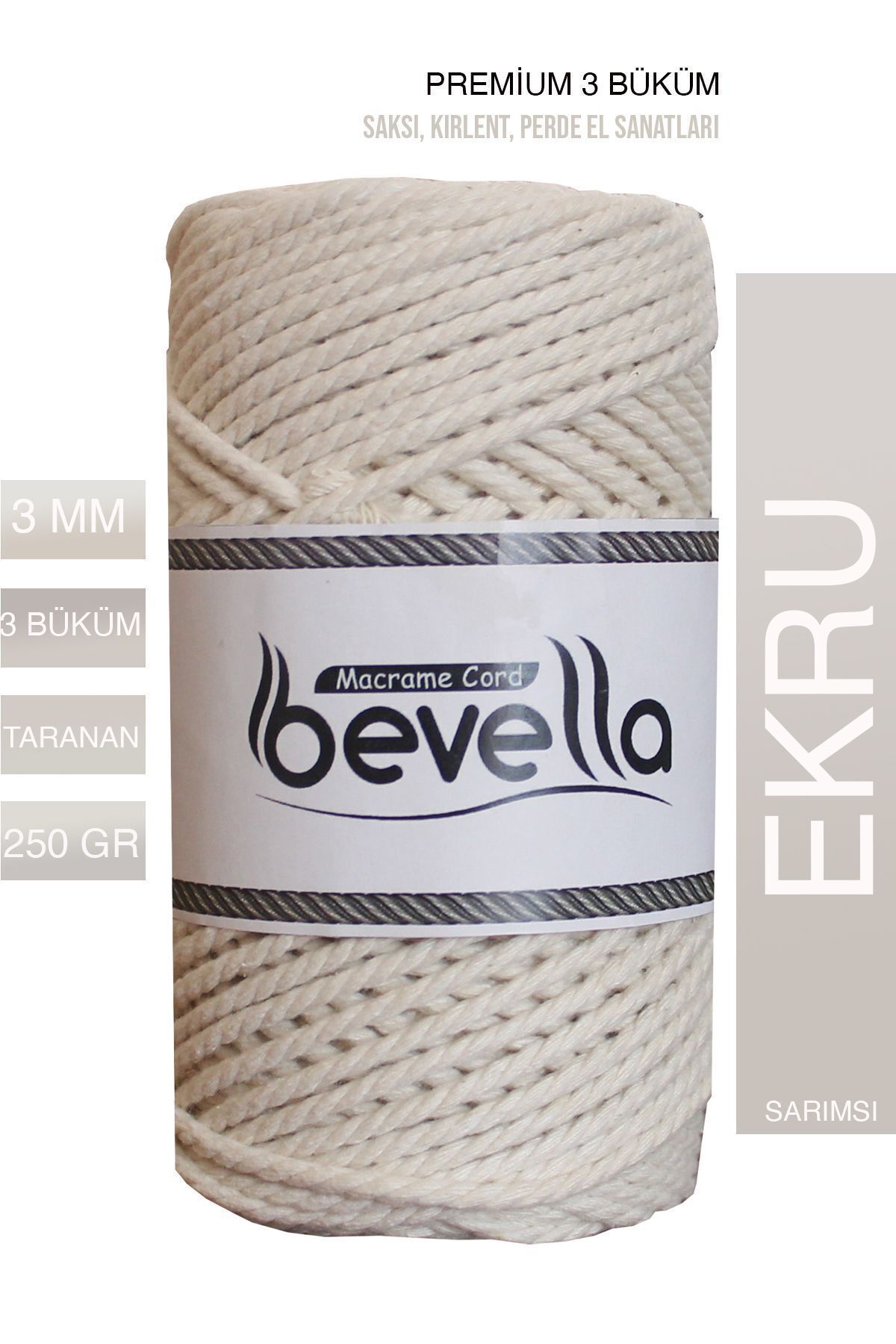
- Bevella's wholesale macrame cord catalog includes the heavy 4 to 6 mm braided polyester and cotton lines required for safe hammock construction.
What Cord Do You Need for a Macrame Hammock?
A safe macrame hammock requires 4 to 6 mm braided polyester or polyester-cotton blend cord with a minimum tensile strength of 100 lb per single line, used in patterns that distribute load across many parallel cords. Single-twist cotton cord, decorative cord, and any cord under 4 mm should not be used as primary structural lines because they fail unpredictably under dynamic loading. The cord at suspension points should be doubled or quadrupled for redundancy.
The reason is load distribution. A finished hammock spreads occupant weight across 30 to 60 parallel cords, so each cord carries a small fraction of the total. A 200 lb occupant in a 50-cord hammock loads each cord to roughly 4 lb under static rest, well within the capacity of standard 4 mm braided cord. The risk is concentration: when load funnels into a few cords at the suspension point, those individual cords can see 50 to 100 lb each, which is where heavier cord and redundancy matter.
Polyester is the standard material because it does not absorb water, resists mildew, holds knots well, and retains tensile strength under sun exposure better than cotton. Cotton macrame cord works for indoor display hammocks and protected covered porches, but for outdoor or marine settings, polyester or polyester-cotton blends carry the safety margin required.
| Cord Diameter | Typical Tensile Strength | Hammock Use |
|---|---|---|
| 3 mm braided | 50 to 80 lb | Decorative only, not structural |
| 4 mm braided polyester | 100 to 150 lb | Body cords, light hammocks |
| 5 mm braided polyester | 200 to 300 lb | Standard hammock body and edges |
| 6 mm braided polyester | 400 to 600 lb | Suspension points, heavy capacity |
| 8 mm braided polyester | 800 to 1,200 lb | Anchor lines, doubled suspension |
Source: Hammock Dream USA cord guide, Home Depot product specifications.
What Weight Capacity Should a Macrame Hammock Carry?
A standard adult macrame hammock should carry a minimum static rated capacity of 250 lb, with the structure designed for at least 5x that load to handle dynamic forces from sitting, swinging, and entry movements. Production hammocks rated 250 to 330 lb static load are tested to roughly 500 lb under ideal conditions, leaving a working safety margin around 1.5 to 2x the rated number.
Static load is the weight when the occupant is at rest. Dynamic load is what happens when they sit down, shift, swing, or stand back up. Dynamic loading multiplies static weight by 2 to 4x momentarily during entry and exit, which is why a 200 lb person in a hammock rated for 250 lb static can still cause failure if they drop in carelessly. Engineering for the actual peak load, not just the at-rest load, is the difference between a safe build and an injury.
The 30-degree hanging angle most manufacturers test at is the geometry where suspension point stress is roughly equal to occupant weight. At 60 degrees (more horizontal), suspension stress drops below occupant weight. At 0 degrees (fully vertical), suspension stress goes to infinity, which is why no hammock can be hung from a single overhead point with the cords running vertically. The hanging angle directly controls how much load actually reaches the suspension points.
| User Weight | Recommended Static Rating | Recommended Suspension Cord Strength |
|---|---|---|
| Under 150 lb | 250 lb minimum | 800 lb each, doubled |
| 150 to 200 lb | 350 lb minimum | 1,200 lb each, doubled |
| 200 to 250 lb | 500 lb minimum | 1,600 lb each, doubled |
| Over 250 lb | 700 lb minimum | 2,000 lb each, doubled |
What Are the Structural Knot Patterns for a Hammock?
The two structural patterns used in macrame hammocks are alternating square knot grids for the body and gathered knot bundles for the suspension points. Square knot grids spread load evenly across the body fabric, while gathered knot bundles funnel many parallel cords into a single anchor point. Decorative knots like Berry knots, sennit chains, and frivolite are added between structural areas but should not bear primary load.
The alternating square knot grid is the primary pattern for hammock body construction. Cords are mounted onto a spreader bar with lark's heads, then square knots are tied between adjacent groups of four cords. The next row alternates by tying square knots between offset groups, which creates a diamond-pattern net that flexes evenly under load. Spacing between knots controls how much the hammock stretches and how the occupant settles into it.
Suspension point construction is where most amateur hammock builds fail. The standard pattern is a gathered knot bundle: all body cords are pulled through a single ring or eye, then wrapped tightly with a heavy gathering knot (Solomon bar or wrapping knot) that holds them together. A second redundant wrap of the same heavy cord goes over the first as a safety. The ring at the top is then attached to the room hardware via a tested carabiner, swivel hook, or chain.
The gathered knot bundle distributes load by friction across many parallel cords. If one cord fails, neighbors take its load through the friction wrap. The wrap material must be heavier than any single body cord because it carries the cumulative load of every cord it wraps. Six millimeter braided polyester is the minimum for the wrap on a standard 30-to-50 cord hammock body.
How Do You Size a Macrame Hammock?
A standard adult lounge hammock measures 200 to 220 cm long by 90 to 110 cm wide in finished body dimensions, with 30 to 60 cm of cord between the body edge and the suspension point on each end. A hammock chair (no full body, just seated) measures 90 to 110 cm wide by 110 to 140 cm tall, with the seat structure starting 60 to 80 cm down from the suspension point.
The width of the spreader bar (if the design uses one) controls how flat the hammock lies. Wide spreader bars (over 100 cm) make the hammock feel more like a flat bed but transfer more load to the side cords; narrow bars (60 to 80 cm) let the hammock cup around the occupant more naturally and load evenly across all cords. Brazilian-style hammocks use no spreader bar at all and rely on the cord bunching to support the body.
Total cord requirement scales with body size and knot density. A standard adult hammock with a medium-density square knot body uses about 1,000 yards (915 m) of 4 mm braided cord. Denser knot patterns increase cord needs to 1,200 to 1,500 yards; sparser patterns drop to 700 to 800 yards. A hammock chair uses roughly half the cord of a full hammock at 500 to 600 yards.
| Hammock Type | Body Size | Cord Total | Working Cords | Suspension |
|---|---|---|---|---|
| Adult lounge hammock | 200 x 100 cm | 1,000 yd | 50 cords x 20 yd | Doubled 6 mm |
| Hammock chair | 100 x 130 cm | 600 yd | 30 cords x 20 yd | Doubled 6 mm |
| Heavy-duty hammock | 220 x 110 cm | 1,400 yd | 60 cords x 23 yd | Quadrupled 6 mm |
| Child swing | 80 x 80 cm | 300 yd | 20 cords x 15 yd | Doubled 5 mm |
What Materials List Do You Need for a Full Hammock Build?
A complete macrame hammock build requires the working cord (1,000 yd of 4 mm polyester), heavier suspension cord (50 ft of 6 mm polyester for gathering wraps), two metal rings or D-rings rated for the design load, two carabiners rated to at least 5x occupant weight, two 25 mm hardwood or metal spreader bars, mounting hardware (eye bolts or swing hangers rated for the load), and hanging chains or webbing straps.
The metal hardware is non-negotiable for safety. Generic key-ring carabiners are not load rated and will fail. Climbing-grade carabiners (rated 22 to 25 kN, about 4,950 to 5,600 lb) are overkill for hammock loads but provide guaranteed margin. Stainless steel eye bolts threaded into a structural beam (not just into drywall or thin furniture) handle the wall or ceiling anchor. Swing hangers with bearings reduce friction and extend cord life.
Spreader bars made from 25 mm diameter hardwood (oak, maple) or thick aluminum tube hold the body open at the head and foot ends. Cheaper bars in soft pine or thin metal tube can crack or bend under shifted load and should be avoided. The bar should be at least 5 cm wider than the hammock body width on each end to prevent the cord lashings from sliding off.
For outdoor installations, all metal hardware should be stainless steel or hot-dip galvanized to resist corrosion. Untreated steel rusts within months in outdoor settings and the rust weakens the load rating dramatically. Marine-grade stainless 316 is the cleanest spec for permanent outdoor hammock installations near water or salt air.
What Are the Safety Steps Before You Use a Macrame Hammock?
Every macrame hammock should pass a five-step safety check before each first use, after any cord repair, and at least once per season for permanent installations: visual cord inspection for fray or weak spots, suspension knot pull test at 2x rated load, hardware load rating verification, hanging angle measurement (target 30 degrees), and a controlled static load test before the first occupied use.
The visual cord inspection looks for fuzzing or unraveling on body cords, cuts or abrasion on suspension cords, and any signs of UV damage (color fade, brittleness when flexed). A single visibly damaged primary cord is grounds to retire the hammock or replace the affected section. Frayed-but-intact decorative cords are cosmetic and can be ignored.
The pull test loads the suspension knots to twice the rated capacity using bricks, water bags, or weights, held for 60 seconds. If knots cinch tighter and stay seated under the test, they are safe for use. If knots slip, twist, or release, the suspension construction is unsafe and must be redone with heavier cord or additional wraps before any person uses the hammock.
The static load test sits the heaviest expected user in the hammock with a spotter for 30 seconds, with no swinging or shifting, before normal use. Listen for any creak, pop, or settle that suggests cord movement under the suspension wrap. Audible cord movement after the first 5 seconds indicates loose knots that need re-tensioning.
Frequently Asked Questions About Macrame Hammocks
How long does it take to make a macrame hammock?
A standard macrame hammock takes 30 to 60 hours of knotting work depending on the body pattern density and the knotter's experience. A simple alternating square knot body with no decorative work runs 30 to 40 hours. Adding Berry knots, fringe, or complex pattern bands stretches the project to 50 to 70 hours total.
Can you use jute or natural rope for a hammock?
Jute and untreated natural rope are not recommended for primary structural hammock construction because they fail unpredictably under dynamic load, lose strength quickly with weather exposure, and grow brittle as they age. Natural rope hammocks exist as decorative or low-load designs (cat hammocks, decorative hangings) but should not bear adult human weight in any safety-critical use.
What's the difference between a Brazilian and Mayan macrame hammock?
Brazilian hammocks use a tightly woven solid fabric body (often quilted cotton) with no spreader bar, while Mayan hammocks use an open lattice of sprang or netting weaving with no spreader bar. Macrame hammocks borrow the no-spreader Brazilian approach but build the body from knotted cord rather than woven cloth, giving the open texture of Mayan work with the cord visibility of macrame.
Can a macrame hammock be hung outdoors?
Yes, with the right materials. Polyester or polyester-cotton blend cord, stainless steel hardware, and weather-resistant wood or aluminum spreader bars all hold up to outdoor use. Pure cotton cord weakens with rain and sun exposure and should be brought inside between uses. UV-rated outdoor polyester cord can stay up year-round in most climates with annual safety inspection.
How do you wash a macrame hammock?
Macrame hammocks can be hand washed in a bathtub with mild detergent and air dried on a flat surface. Spot cleaning with a soft brush handles most marks. Machine washing is risky because the agitator can tangle and stress the cord work. Polyester hammocks tolerate cleaning better than cotton; cotton hammocks should be air dried completely before re-hanging to prevent mildew.
What height should you hang a macrame hammock?
Standard hanging height puts the lowest point of the hammock body about 45 to 60 cm off the ground for safe entry and to allow some ground clearance under occupant weight. Suspension points typically sit 200 to 240 cm above the floor, with a horizontal distance between anchors of 300 to 400 cm. Adjust the chain or strap length to land the rest position at the target ground clearance.
A macrame hammock is one of the few projects where cord choice is a real engineering decision rather than just an aesthetic one. Cord under 4 mm, single-twist construction, untreated natural fibers, and unrated metal hardware all create real injury risk. The right materials (4 to 6 mm braided polyester, climbing-rated hardware, doubled suspension wraps) and a five-step safety check before each major use make the difference between a decorative knot project and a safe daily-use piece. Bevella supplies the heavier 4 to 6 mm braided polyester cord lines that hammock construction needs, sourced from our wholesale Turkish manufacturing operation.
Sources cited: Hammock Dream USA (Cord Requirements for Macrame Hammock), Home Depot (HOMEFUN 47 in. 330 lb Macrame Hammock product specifications), Outside Luxe (Understanding Hammock Load Capacity), Living in Sunshine (How to Calculate Hammock Weight Limit), Pro Hammocks (Will a Paracord Hold a Hammock), Hammocks.company (Hammock Weight Limits Guide), Hammock Forums archived discussions on safe working load.