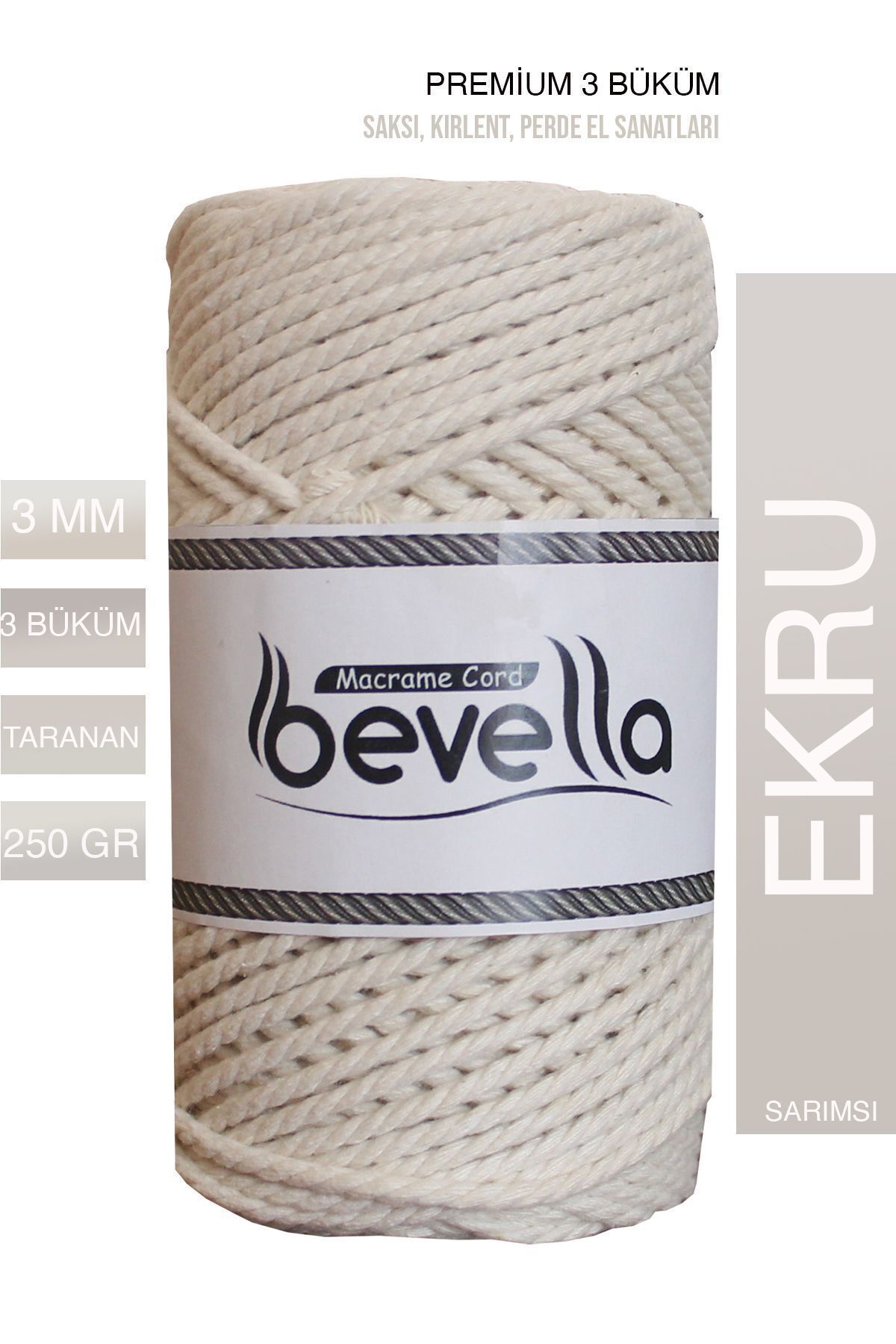
Macrame Cord Weight Guide: How to Match Ply and Thickness to Your Project
Macrame cord weight controls knot density, drape, the hours a project takes, and how a finished piece hangs on the wall. Choose a cord that is too light and your wall hanging looks flimsy. Choose one too heavy and your jewellery becomes uncomfortable. This guide walks through ply, grams per metre, and the right cord weight for each common project so your next order matches the work in front of you.
Key Takeaways
- Cord weight is set by three factors: fibre type, thickness in millimetres, and ply or twist construction.
- According to the Cordage Institute, twist direction and ply count directly affect a cord's load-bearing performance and dimensional stability.
- Most macrame studios stock three weight ranges: light (1 to 3 mm) for jewellery, medium (4 to 6 mm) for wall hangings, and heavy (8 mm and up) for plant hangers, hammocks and installations.
What does cord weight actually mean?
In macrame, cord weight covers two related ideas. The first is grams per metre, a physical mass figure used by suppliers to price and ship cord. The second is the visual and structural weight of the cord, which depends on thickness, fibre and ply. Both numbers matter: grams per metre tells you how much you need to buy, while structural weight tells you how the cord will behave under tension and after it hangs for a few months.
Grams per metre as a buying unit
Wholesale macrame cord is sold by kilogram, but converting to grams per metre helps when you plan a project. A 4 mm single-twist cotton cord typically lands near 13 to 16 grams per metre. A 5 mm 3-ply cotton cord sits closer to 22 to 28 grams per metre. Always ask your supplier for the exact figure on the batch you are ordering, because fibre lots vary.
Why ply matters more than diameter alone
Two cords measured at the same 5 mm can carry very different weights and behave very differently in knots. A loose single-strand cord at 5 mm is fluffy, light and frays easily into a brushed fringe. A tight 3-ply cord at the same 5 mm is denser, heavier and holds knot edges crisp. Treat ply as a separate decision from diameter rather than a fixed pairing.
Single strand vs 3-ply vs multi-ply
The three main ply families cover almost all macrame work. Each has a typical use case, a typical finish, and a typical price band. Choosing among them is usually the first decision a buyer makes after the colour.
Single strand cord
Single strand cord, also called single twist or string, is one bundle of fibres twisted in a single direction. It is the lightest construction at any given diameter, brushes out into soft fringe, and is the cheapest version of cotton macrame cord by weight. It is the standard choice for fringed wall hangings, tassels and any project that ends in a brushed-out finish.
3-ply twisted cord
3-ply cord is built from three sub-strands twisted around each other. It is denser, heavier per metre, and produces sharp, defined knots. It does not brush out into soft fringe because the sub-strands hold their twist. Use 3-ply for plant hangers, structured wall hangings, and any project that needs a clean, professional knot finish.
Braided and multi-ply cord
Braided cord, often eight-strand or sixteen-strand, has a hollow or core-and-cover construction. It carries the most weight per metre at any given diameter and resists kinking. It is the right choice for hammocks, swings, large wall installations and projects where the cord itself becomes a structural element.
How weight affects knot density and drape
A heavier cord forms a denser knot pattern with more visual impact per square centimetre. A lighter cord flows and drapes, ideal for soft, romantic finishes. Beyond aesthetics, weight changes the practical behaviour of a piece on the wall, on a body or in a window.
Knot density on the same pattern
The same square knot pattern worked in 3 mm cord versus 6 mm cord produces a noticeably different look. The 3 mm version reads as fine lacework, while the 6 mm version reads as bold, textured texture. If you are scaling a pattern up or down, expect to recalculate cord lengths because heavier cord eats more length per knot.
Drape and movement
Light, single-strand cotton in 2 to 3 mm drapes softly and moves with air. It is forgiving on curtains, bag straps and clothing trims. Heavy 3-ply or braided cord at 8 mm and above hangs straight, holds its shape, and reads as a sculptural statement. Match drape to the room: airy curtains versus a fixed sculptural panel.
Cord weight guide by project type
The right cord weight depends on whether the work hangs, holds, wraps or is worn. Use this section as a starting point, then adjust by 1 mm up or down based on your personal style.
Jewellery and small accessories
For necklaces, bracelets, anklets and earrings, choose 0.5 mm to 2 mm cord. Waxed polyester, nylon and fine cotton sit in this range. Keep weight low so the piece is comfortable against skin and the knots stay small enough to thread beads through.
Bag straps and small wearables
For tote handles, phone straps and belts, 3 mm to 4 mm cord works best. This range is light enough to wear but strong enough to support contents. Choose 3-ply cotton or braided polyester for straps that will carry weight day after day.
Wall hangings
Standard wall hangings sit comfortably in the 4 mm to 6 mm range. A 5 mm single-strand cotton remains the most popular wall hanging choice for fringe-heavy work, while 5 mm 3-ply suits geometric, knot-led patterns. Reserve 6 mm and up for large statement pieces over 80 cm wide.
Plant hangers
Plant hangers need 4 mm to 6 mm cord with enough strength to support a soil-filled pot. 3-ply construction is preferred because it holds knots tightly under sustained load. For large outdoor planters, step up to 8 mm braided cord.
Curtains, room dividers and large panels
Curtains and room dividers benefit from 5 mm to 8 mm cord depending on panel size. Calculate cord weight per square metre of finished panel and confirm your curtain rod can support it. A finished macrame curtain at 1 m by 2 m can weigh 3 to 6 kg.
Hammocks, swings and installations
For hammocks, swings and installations over 1.5 m wide, use 8 mm to 20 mm braided or 3-ply cord. These projects carry human weight or hang in public spaces, so prioritise tested load ratings from the supplier and use rated hardware.
A quick grams per metre reference
The reference list below maps cord diameter and construction to typical grams per metre, the figure that connects spool weight to actual length you can knot with. Numbers cover 2mm single twist cotton up to 12mm braided cotton, the range that covers nearly every retail and wholesale macrame project. These figures are typical for cotton cord and shift slightly between mills and batches, so confirm exact numbers with your supplier before placing a bulk order.
- 2 mm single twist cotton: 4 to 6 g/m
- 3 mm single twist cotton: 8 to 10 g/m
- 4 mm single twist cotton: 13 to 16 g/m
- 5 mm single twist cotton: 18 to 22 g/m
- 5 mm 3-ply cotton: 22 to 28 g/m
- 6 mm 3-ply cotton: 32 to 38 g/m
- 8 mm 3-ply cotton: 55 to 65 g/m
- 12 mm braided cotton: 110 to 130 g/m
Frequently Asked Questions About Macrame Cord Weight
How do I calculate how much cord weight to order for a project?
Multiply the planned finished length by 4 to 6 to get the working cord length per strand, then multiply by the number of strands and the grams per metre figure. A 60 cm finished wall hanging with 24 strands of 5 mm cord at 20 g/m needs about 60 cm by 4 by 24 by 20 g, or roughly 1.15 kg of cord.
Does heavier cord always look more premium?
Not always. Heavy cord reads as bold and architectural, but a fine 2 mm jewellery piece can look just as premium because it shows precision and skill. Match cord weight to the design intent rather than defaulting to the heaviest cord on the shelf.
Can I mix different cord weights in the same piece?
Yes. Mixed-weight pieces work well when the design has a clear hierarchy, such as a 5 mm structural frame with 2 mm fine detail inside. Plan the lighter cord around the heavier cord, and choose colours that read as a single palette so the contrast feels intentional.
Why does my finished piece weigh more than I calculated?
Knot tightness adds mass-per-area beyond the simple grams per metre figure because tight knots compress more cord into less visible length. Add roughly 10 percent to your calculation for tightly knotted designs, more for dense square knot panels.
Is there a weight limit for shipping macrame projects?
Most courier services charge by volumetric weight as well as actual weight, and macrame pieces are bulky. A 2 kg wall hanging may ship at a 5 kg billable rate. Compress and roll the piece, then check both weights against your courier's chart before quoting shipping to customers.
Cord weight feels like a technical detail until a project goes wrong, at which point it is usually the first thing to investigate. Build the habit of writing down cord diameter, ply construction and grams per metre on every project sheet, even hobby pieces. Over time, the data turns into a personal reference better than any general chart, and your next cord order arrives matched to the work you actually do.
Sources cited: Cordage Institute Standard Test Methods, Bevella production data 2024.