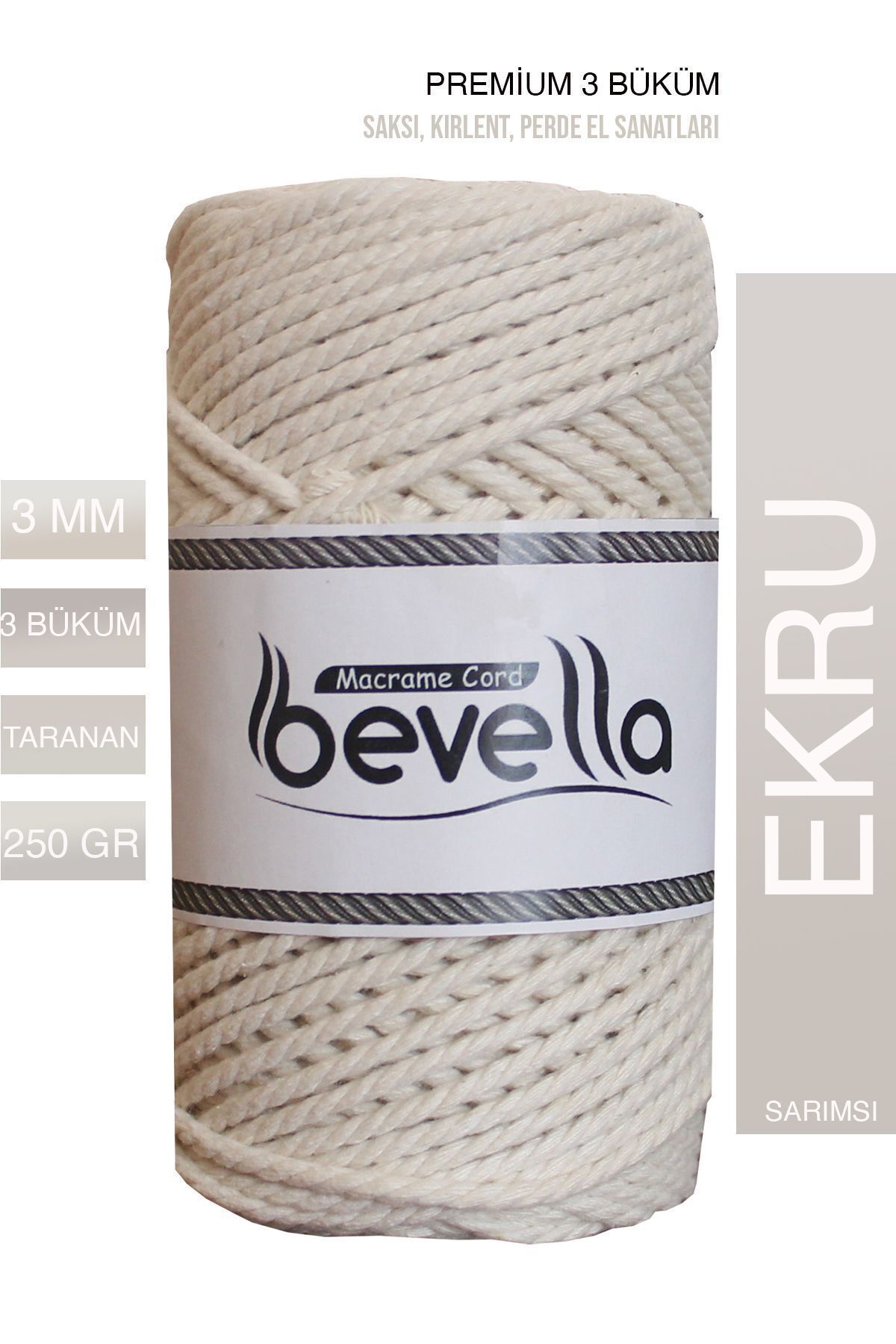
Macrame Cord Length Chart: Complete Reference for Projects
A reliable macrame cord length chart starts from the 4x rule, adjusts for knot density, accounts for cord thickness, and adds a 10 to 20 percent buffer for waste. This page collects the project-specific tables most makers reach for repeatedly: wall hangings, plant hangers, keychains, bags, hammocks, and curtains, with the math that lets you adapt any chart row to a different finished size.
Key Takeaways
- The 4x rule: cut each cord at 4 times the finished project length, then double when folded with a lark's head
- Wall hangings with mixed knot work and fringe need 6x to 8x the finished length per cord
- A simple 1 m plant hanger in 5 mm cotton needs about 20 m of cord across 8 strands
- Add 10 to 20 percent buffer for tension variation, knotting mistakes, and trimming
- Thicker cord at the same project size needs more cord per knot — multiply yardage by 1.2 to 1.4 when stepping up two cord sizes
- Tightly knotted sections consume cord 1.5 to 2x faster than open mesh
How Does the 4x Rule Work for Macrame Cord Length?
The 4x rule says cut each working cord at 4 times the finished project length. When you fold the cord in half through a lark's head knot at the start, you double the cord count and halve the working length per strand — which means the original cord must be at least 8 times the finished length to leave enough cord for knots.
The 4x rule is the standard baseline: each working cord cut at 4 times the finished project length, then folded in half via a lark's head knot for double the working strands. Wall hangings with mixed dense knot zones and open fringe typically need 6x to 8x cord per finished length. Add 10 to 20 percent buffer for waste (Marching North, 2024; Macrame.ie, 2024).
When the 4x Rule Underestimates
Three situations where 4x is not enough:
- Dense knot panels: Sections of square knots or berry knots without gaps consume cord 1.5 to 2x faster than open mesh
- Heavy fringe: Thick fringe past 30 cm long adds 30 to 50 percent to total cord need
- Beaded sections: Beads slow cord flow through knots and add 5 to 10 percent friction loss
For a project with these features, switch from 4x to 6x or 8x as the multiplier and add a 20 percent waste buffer instead of 10.
Why Beginners Run Short
Three reasons new makers hit the dreaded "ran out of cord" problem:
- Forgetting to fold the cord through a lark's head, which doubles the strand count but halves working length
- Underestimating how fast tight knots eat cord
- Skipping the waste buffer entirely
Cut all cord before starting the project. Recutting halfway through never matches the original tension or color lot.
How Much Cord Do You Need for a Wall Hanging?
A typical 50 by 70 cm cotton wall hanging in 4 to 5 mm cord needs 60 to 90 meters of cord total across 12 to 20 working strands. Larger pieces with dense knot work climb fast — a 100 by 150 cm statement piece can pass 250 to 350 meters. Wall hangings combine dense knots with open mesh and fringe, so plan with the 6x to 8x multiplier rather than basic 4x.
Wall Hanging Cord Chart (5 mm Cotton)
| Finished Size (W x H) | Strand Count | Cord per Strand | Total Cord |
|---|---|---|---|
| 30 x 40 cm | 8 | 3.2 m | 26 m |
| 50 x 70 cm | 14 | 5.6 m | 78 m |
| 70 x 100 cm | 20 | 8 m | 160 m |
| 100 x 150 cm | 28 | 12 m | 336 m |
| 120 x 180 cm | 32 | 14.4 m | 460 m |
These figures assume 6x cord per finished height plus a 15% buffer. Adjust upward 25 to 30% if your design uses heavy fringe past 30 cm or full-density knot panels.
Adjustments Within the Wall Hanging Range
- Open mesh dominant: Multiply chart total by 0.85
- Dense knot panels dominant: Multiply chart total by 1.3
- Heavy fringe past 30 cm: Add 0.4 m per strand
- 3 mm cord instead of 5 mm: Multiply by 0.75
- 6 mm cord instead of 5 mm: Multiply by 1.25
How Much Cord Do You Need for a Plant Hanger?
A simple 1 m long plant hanger in 5 mm cotton needs roughly 20 to 25 meters of cord across 8 working strands. Each strand cuts at 4 times the finished hanger length, then doubles through the lark's head at the gathering knot. A 1.5 m hanger climbs to 35 to 45 meters; a 2 m hanger needs 50 to 60 meters total.
Plant Hanger Cord Chart (5 mm Cotton, 8 Strands)
| Finished Length | Cord per Strand | Total Cord |
|---|---|---|
| 70 cm | 2.8 m | 25 m |
| 100 cm | 4 m | 36 m |
| 130 cm | 5.2 m | 47 m |
| 150 cm | 6 m | 54 m |
| 180 cm | 7.2 m | 65 m |
| 200 cm | 8 m | 72 m |
Numbers include 12% buffer for knotting and trimming.
Plant Hanger Adjustments
- 6 strands instead of 8: Multiply by 0.75
- 12 strands (heavy decorative): Multiply by 1.5
- Triple knot bands instead of single: Add 30 percent
- Heavy fringe past 25 cm at the bottom: Add 0.5 m per strand
- 3 to 4 mm cord: Multiply by 0.75
- 6 to 8 mm cord: Multiply by 1.3
How Much Cord Do You Need for Smaller Projects?
Smaller projects (keychains, bracelets, jewelry, plant hanger basics) follow the same 4x rule but the absolute numbers stay forgiving. A standard keychain takes 2 to 4 meters; a friendship bracelet takes 1.5 to 3 meters; a beaded plant hanger basic body needs 8 to 12 meters per strand.
Small Project Cord Chart
| Project | Cord Diameter | Total Cord Needed |
|---|---|---|
| Friendship bracelet | 1 mm waxed | 1.5 to 3 m |
| Beaded keychain | 2 mm | 2 to 4 m |
| Tassel keychain | 3 mm | 3 to 5 m |
| Choker necklace | 1 to 2 mm | 2 to 3 m |
| Macrame earrings (pair) | 1 mm | 2 to 4 m |
| Camera strap | 4 mm | 6 to 10 m |
| Phone lanyard | 2 mm | 1.5 to 3 m |
| Bag handle (single) | 4 to 5 mm | 4 to 6 m |
| Coaster (10 cm) | 3 mm | 4 to 6 m |
| Table runner (40 x 120 cm) | 4 mm | 60 to 90 m |
Small projects forgive miscalculation; the cost of being 1 m short on a keychain is recoverable. Still, cut all cord before knotting to keep tension and color consistent.
How Much Cord Do You Need for Curtains, Bags, and Hammocks?
Larger functional pieces (curtains, bags, hammocks) need substantially more cord than decorative wall hangings of similar size. A 90 by 185 cm window curtain in 5 mm cotton uses 230 to 270 meters; a structured macrame bag uses 60 to 120 meters; a one-person hammock uses 400 to 600 meters depending on density.
Functional Project Cord Chart
| Project | Finished Size | Cord Diameter | Total Cord |
|---|---|---|---|
| Window curtain | 60 x 120 cm | 5 mm | 110 to 130 m |
| Window curtain | 90 x 185 cm | 5 mm | 230 to 270 m |
| Door curtain | 90 x 200 cm | 4 mm braided | 380 to 430 m |
| Wide curtain | 120 x 200 cm | 4 mm braided | 540 to 600 m |
| Tote bag | 30 x 35 cm | 4 mm | 80 to 110 m |
| Crossbody bag | 25 x 30 cm | 3 mm | 60 to 90 m |
| Beach bag (large) | 40 x 45 cm | 5 mm | 130 to 170 m |
| Hammock (one person) | 100 x 200 cm | 5 to 6 mm | 400 to 600 m |
| Hammock (two person) | 140 x 220 cm | 6 mm | 600 to 850 m |
| Porch swing | 60 x 100 cm seat | 6 to 8 mm | 280 to 380 m |
Cord totals include 15 to 20% buffer for safety on load-bearing items.
Hammock and Swing Specific Notes
Hammocks and swings demand higher safety margins because failure means a fall. Add an extra 10% buffer beyond the chart, choose hemp or polyester over cotton for load-bearing strands, and double-check the breaking strength of your chosen cord against the rated user weight.
How Do You Adjust Charts for Different Cord Thicknesses?
Cord thickness changes both the visual scale and the cord consumption per knot. A 6 mm cord in the same project as a 4 mm cord uses 25 to 35 percent more cord because each knot wraps a larger circumference. Thinner cord trades opposite — a 3 mm cord in place of a 5 mm cord cuts cord need by 25 to 30 percent.
Thickness Multiplier Table
| If Chart Lists 5 mm | Multiply Total Cord By |
|---|---|
| 2 mm cord | 0.55 |
| 3 mm cord | 0.75 |
| 4 mm cord | 0.85 |
| 5 mm cord (baseline) | 1.0 |
| 6 mm cord | 1.25 |
| 8 mm cord | 1.55 |
Thickness Choice by Project Weight
- Decorative wall art (no load): 3 to 5 mm
- Light plant pots (under 3 kg): 4 mm
- Medium plant pots (3 to 6 kg): 5 mm
- Heavy plant pots or load (6 to 10 kg): 6 mm
- Hammocks, swings, body weight: 6 to 8 mm hemp or polyester only
Cord Type Affects Yardage Too
Twisted (single-strand) cord and braided cord behave differently in knots. Braided cord holds knot definition at lower cord-per-knot consumption; twisted cord puffs slightly when knotted, demanding 5 to 10 percent more length per knot for the same finished tension.
Why Do You Need a Waste Buffer in Cord Calculations?
Cord lost to tension variation, knotting mistakes, and trimming adds up to 10 to 20 percent of the calculated total. A project that math says needs 100 m typically uses 110 to 120 m in practice. Skipping the buffer is the single most common cause of running short mid-project. Sources commonly recommend 10 to 20 percent additional cord beyond clean math estimates.
Where Waste Comes From
- Tension variation: Cord under different knot tension finishes at different lengths
- Knot mistakes: Untying and retying eats 0.3 to 1 m per correction
- Trimming for fringe: Final cuts to level the fringe lose 5 to 15 cm per strand
- Skill level: New makers waste 15 to 25 percent more cord than experienced ones
Buffer Recommendations by Skill Level
| Skill Level | Recommended Buffer |
|---|---|
| First-time maker | 25% |
| 5 or fewer projects completed | 20% |
| 5 to 20 projects | 15% |
| 20+ projects | 10 to 12% |
| Production maker | 8 to 10% (per-batch ratio) |
Buying Tip
When ordering cord based on chart math, round up to the nearest spool. A spool you have in stock is cheaper than a rush reorder mid-project at retail tier pricing.
Frequently Asked Questions About Macrame Cord Length
What is the most common macrame cord length mistake?
Forgetting that a lark's head knot folds the cord in half, doubling the strand count but halving working length. This means if you need 4 m of working strand for a 1 m project, you must cut 8 m before folding. Many beginners cut 4 m and run short of cord at the second knot row.
How do I calculate cord for an irregular project?
Break the project into zones — header, body, fringe — and calculate each zone separately. Header and dense knot zones need 6x finished height per cord; open mesh zones need 4x; fringe needs straight length plus 15% trim allowance. Sum the zones and add a 15% overall buffer.
Should I buy more cord than the chart says?
Yes. Buy 15 to 20 percent more cord than chart math suggests, especially for first attempts at a project type. The cost of extra cord is small against the cost of a half-finished piece waiting for a reorder. Leftover cord becomes the supply for keychains, bracelets, and small samples.
How does cord type (twisted vs braided) change yardage?
Braided cord uses 5 to 10 percent less cord per finished knot than twisted cord because braid holds knot definition without puffing. Twisted cord puffs slightly under tension, requiring marginally more cord for the same finished tightness. Keep this in mind when switching cord type without changing project specs.
Can I use leftover cord from one project on another?
Yes, but match it to projects where slight variation does not show. Mix-and-match scraps work for small accents, samples, jewelry, and tassels. For larger statement pieces, keep all cord from the same lot — even small dye-lot variations show in finished work.
Why do my cord lengths come out shorter than the chart predicts?
Three usual causes: tighter-than-average knot tension, denser knot patterns than the chart assumes, or thicker cord than specified. Track your actual usage against chart predictions for the first 5 projects to learn your personal multiplier. Most makers settle 5 to 15 percent above standard chart values.
A cord length chart is a starting point, not a guarantee. Run your math, add a buffer, cut all cord before starting, and document your actual usage on the first attempt of any new project type. Over 10 to 15 projects, your personal multipliers stabilize and chart math becomes reliable within 5 percent. Save the page in your project notebook for the next time you start a hanger, a curtain, or a wall piece.
Sources cited: Marching North Cord Estimating Guide, Macrame.ie Cord Calculator, Home Vibes Macrame Cord Tips, Bochiknot Macrame Cord Measuring Guide, Macrame for Beginners Cord Length Reference