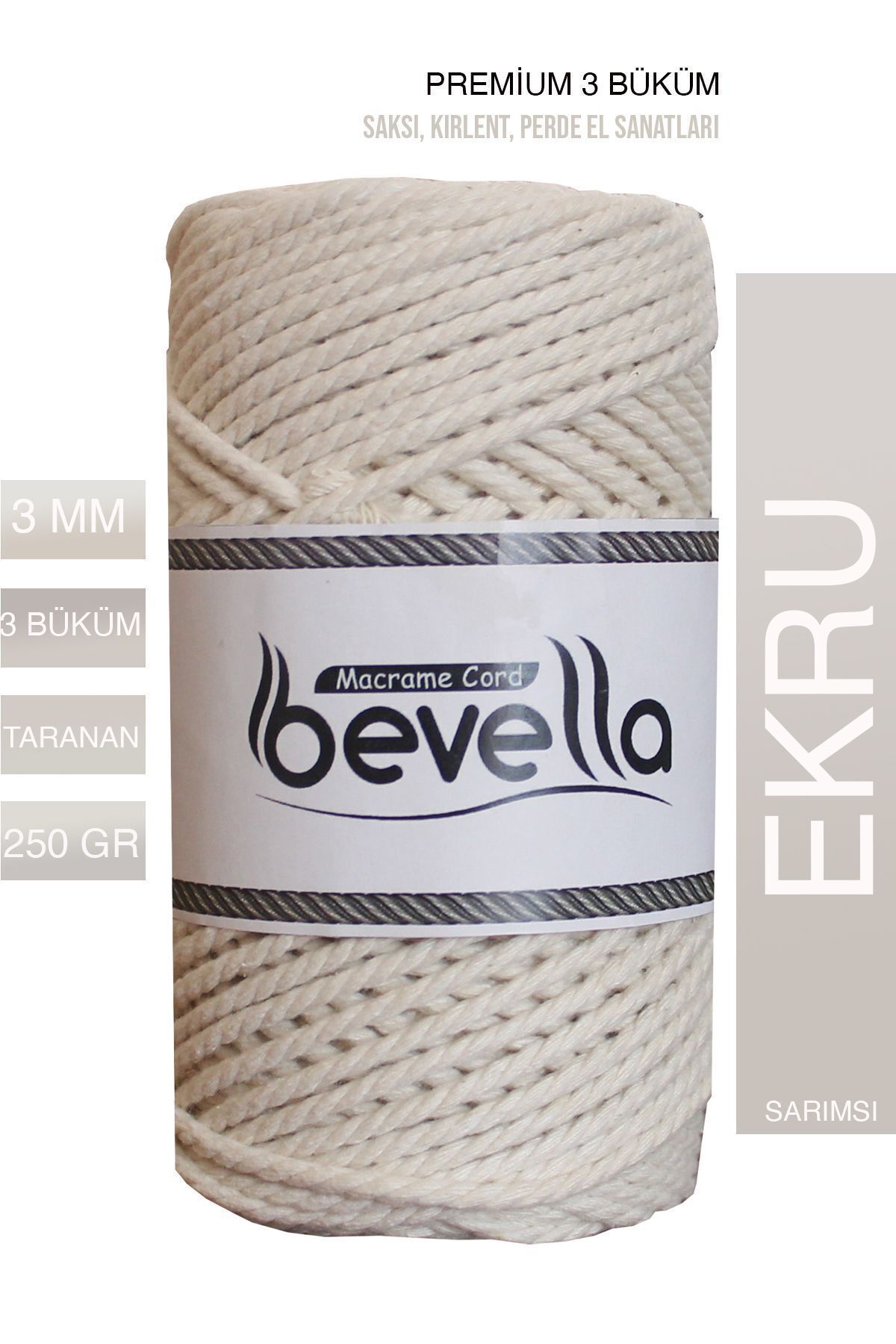
Macrame Coasters and Table Runner: DIY Patterns Guide
TL;DR: A macrame coaster table runner set uses 8 to 15 m of 3mm to 4mm cotton cord per coaster set (each coaster 10 to 12 cm wide) and 90 to 130 m of 4mm cord per standard 45 x 150 cm runner. Coasters use spiral or grid patterns; runners use flat-weave knot grids. Cotton cord handles drink condensation and brief heat exposure; synthetic cord melts under hot dishes.
Key Takeaways
- 3mm to 4mm cotton single-strand cord is the standard for coasters; 4mm for runners
- The U.S. handmade home textile market grew to $9.6B in 2024, with table linens a leading category
- Standard coaster diameter is 10 to 12 cm; standard runner size is 45 x 150 cm
- Cotton cord handles brief 80°C dish contact; polyester melts at 250°C and degrades at 150°C (Cordage Institute, guidelines)
- Spiral coasters and flat grid runners cover the most popular handmade-shop styles
What Are Flat Macrame Coasters and Runners?
Flat macrame coasters and runners are knotted on a horizontal surface instead of hanging from a wall, which produces a flat, even-edged piece suitable for table use. The U.S. handmade home textile market reached $9.6 billion in 2024, with table linens one of the fastest-growing handmade subsegments at over 11% annual growth. Coasters and runners suit handmade gifting and small-shop sales because they finish quickly and use minimal cord.
The U.S. handmade home textile market reached $9.6 billion in 2024, with table linens growing 11% annually. Macrame coasters and runners are popular handmade-gift categories because they use 8 to 120 m of cord per project and finish in 1 to 6 hours.
In Bevella's 2025 wholesale data, table-linen cord (3mm and 4mm cotton in 50 m to 100 m spools) accounts for 12% of small-business cord sales, ranking second behind plant hanger cord.
What Cord Thickness Works Best for Coasters and Runners?
3mm cotton single-strand cord is the standard for coasters because it produces tight, flat knots that stay under a glass without bunching. 4mm cotton works better for table runners because the larger knot scale reads correctly across a 30 cm wide piece. Avoid thicker cords (5mm and above) for table use, since the bulk lifts dishes off level.
Coasters: 3mm to 4mm Cotton Single-Strand
3mm cord makes a 10 cm round coaster sit at 4 to 5 mm thick, which is the sweet spot for stability and visual proportion. 4mm cord makes a 12 cm coaster with bolder knot definition, ideal for bigger glasses and dinner-table use. Use single-strand cotton for the soft, slightly fuzzy finish that absorbs condensation from cold drinks. Each coaster uses 2 to 4 m of cord depending on pattern density.
Runners: 4mm Cotton Single-Strand or 3-Ply Twisted
4mm cord works for runners because the knot scale matches the runner's width. A 30 cm wide runner with 3mm cord looks too thin and busy; the same runner in 5mm looks bulky. 3-ply twisted cord adds a textured finish that hides crumbs and minor staining better than single-strand cotton.
How Much Cord Do You Need for a Coaster Set?
A standard set of 4 coasters uses 8 to 15 m of 3mm cotton cord, depending on pattern complexity. A simple square-knot grid coaster uses 2 m per coaster (8 m for 4). A detailed diamond or chevron pattern uses 3 to 4 m per coaster (12 to 16 m for 4). Always cut 20% extra for safety.
Cord Length Table for Coasters
| Coaster Style | Pattern | Size | Cord per Coaster |
|---|---|---|---|
| Simple grid | All square knots | 10 x 10 cm | 2 m |
| Diamond | Square + double half hitch | 10 x 10 cm | 3 m |
| Chevron | Diagonal double half hitch | 10 x 10 cm | 3.5 m |
| Star or geometric | Mixed knots | 10 x 10 cm | 4 m |
| Round coaster | Concentric square knots | 10 cm dia | 4.5 m |
Source: Compiled from Bevella Macrame Cord 2025 project measurement data and reader-submitted patterns.
Why Cord Use Varies by Pattern
Simple grids of straight square knots use the least cord because every knot stays in one plane. Diagonal and crossing patterns (chevron, star) consume more cord because the cord travels across the piece at an angle, which adds path length. Round coasters use the most cord since the spiral construction wraps cord through every row.
How Much Cord Do You Need for a Table Runner?
The standard handmade table runner size is 45 cm wide by 150 cm long, which uses 110 to 130 m of 4mm cotton cord. The 45 x 150 cm size suits 6-seat dining tables (120 to 150 cm long) and gives the right 15 cm overhang at each end. Most patterns mount 22 to 26 starting cords on a temporary horizontal anchor (a dowel or PVC pipe), which produces the 45 cm finished width.
The standard handmade table runner is 45 cm wide by 150 cm long, fitting 6-seat dining tables. The build uses 22 to 26 starting cords cut to 5 m each, totaling 110 to 130 m of 4mm cotton cord (from project measurement data 2025).
Cord Length Table for Runners
| Runner Length | Width | Starting Cords | Cord per Cord | Total Cord |
|---|---|---|---|---|
| 80 cm | 30 cm | 16 cords | 3.5 m | 56 m |
| 100 cm | 35 cm | 18 cords | 4 m | 72 m |
| 150 cm (standard) | 45 cm | 22 to 26 cords | 5 m | 110 to 130 m |
| 180 cm | 45 cm | 22 to 26 cords | 6 m | 132 to 156 m |
| 200 cm | 50 cm | 26 cords | 7 m | 182 m |
Source: Compiled from Bevella Macrame Cord 2025 project measurement data and runner-pattern testing.
Why Runners Use So Much Cord
Square knot patterns compress cord by 75% as they tie. A 100 cm runner with full square-knot coverage tied across a 30 cm width uses far more cord than the visible 30 m of cord-on-table would suggest. The 4x rule plus 30% buffer applies to runners exactly as it does to wall hangings.
How Do You Set Up Flat Macrame Work?
Flat macrame work needs a horizontal anchor and a flat working surface, instead of the vertical anchor used for wall hangings. The simplest setup uses a 30 cm wood dowel taped to a foam board or table, with cords attached using lark's head knots and worked downward across the flat surface.
The Foam Board Method
Tape a 30 cm dowel to the top edge of a 50 x 70 cm foam board with painter's tape. Pin the cord ends to the foam with T-pins as you work down the row. The pins hold tension while you tie each row, which produces straighter edges than free-hand flat work.
The Clipboard Method
Clip a smaller dowel (15 to 20 cm) to a clipboard, useful for coaster work where the piece is small enough to fit on the clipboard surface. Move the clip down the cord as the coaster grows. This method works well for travel and for small projects under 15 x 15 cm.
The Tape-and-Tabletop Method
Tape the dowel directly to a smooth tabletop. Less control than foam or clipboard, but the simplest setup if you do not want to buy materials. Use this method for first attempts at flat work, then upgrade to a foam board.
What Knot Patterns Work Best for Flat Pieces?
Square knots and double half hitches cover roughly 90% of flat-pattern designs. The square knot creates the dense, flat surface ideal for coasters. The double half hitch creates the diagonal lines, V-shapes, and chevrons that define runner patterns. Most published runner and coaster patterns use only these two knots in different combinations.
Square Knot Grids
A grid of square knots tied across all working cords produces a dense, flat fabric. Use this pattern for the body of coasters, placemats, and runners where you want a uniform texture. Vary the size of the grid by changing the number of cords per knot (the standard is 4 cords per knot).
Double Half Hitch Diagonals
A row of double half hitches tied at a 45-degree angle creates a clean diagonal line across the piece. Stacked diagonals produce the V-shape and diamond patterns common in runners. Two opposing diagonals meeting in the middle form a chevron.
Alternating Square Knots
Alternating square knots shift the knot position by half a cord-pair on each row. This creates the open lattice pattern that suits runners with a lacy, light feel rather than a dense, fabric feel.
How Do You Make a Spiral Coaster Pattern?
The spiral coaster is the most popular round-coaster style and uses 4 to 5 m of 3mm cotton cord per coaster. The pattern starts from a center ring and works outward in concentric rings of square knots, with each ring offset by half a knot to create the spiral effect. A typical 10 cm spiral coaster finishes in 25 to 40 minutes once the technique clicks.
Step 1: Cut Cord and Prepare Center Ring
Cut 8 cords at 50 cm each. Tie all 8 cords together at their midpoints with a small overhand knot, leaving 16 working strands radiating outward. The midpoint knot becomes the coaster center.
Step 2: Tie the First Ring
Group the 16 strands into 4 sets of 4. Tie a square knot at each set, working in a circle around the center. The first ring sits roughly 1 cm from the center.
Step 3: Offset and Tie the Second Ring
Shift the cord groupings by half a knot (take 2 strands from one group and 2 from the next neighboring group). Tie a square knot at each new grouping. The offset creates the visible spiral lines.
Step 4: Continue Outward
Repeat the offset-and-tie sequence for 4 to 6 more rings, working outward to a 10 cm finished diameter. Each ring uses about 0.5 m of cord per square knot.
Step 5: Finish the Edge
Trim cord ends to 1 to 1.5 cm beyond the last ring. Brush the trimmed ends with a steel pet brush to fluff the edge into a soft fringe halo, or seal each end with fabric glue for a clean finish.
How Does Cotton Compare to Synthetic Cord for Heat Resistance?
Cotton cord handles brief contact with warm dishes (up to 80°C) without damage, while polyester cord melts at 250°C and starts to deform at 150°C (Cordage Institute, guidelines). For coasters and runners that meet hot dishes, mugs, and serving plates, cotton is the only safe choice. Polyester runners under hot serving dishes can melt, fuse to dish bottoms, or stain from heat-set residue.
Cotton cord ignites at 410°C and chars at 250°C, but handles brief contact with warm dishes up to 80°C without damage. Polyester melts at 250°C and deforms at 150°C, which makes it unsafe under hot serving dishes (Cordage Institute, guidelines).
Cotton Heat Behavior
Cotton fibers char rather than melt. Brief contact with a 70 to 80°C mug or 60°C dish leaves no visible damage. Sustained contact with a 100°C+ pot can scorch the cord, leaving a brown mark and weakening the fibers at the contact point. Cotton coasters and runners are safe for everyday hot drinks and warm dishes.
Polyester Heat Behavior
Polyester melts at 250°C, which is below the surface temperature of cast-iron skillets (300 to 400°C) and oven-fresh ceramic dishes (200 to 250°C). A polyester runner under a hot dish can melt, fuse to the dish, and leave permanent damage on both the runner and the dish. Reserve polyester for cold-only use cases (cocktail coasters, beverage trays).
Jute Heat Behavior
Jute chars at slightly lower temperatures than cotton (around 200°C vs 250°C) and is more flammable due to lignin content. Avoid jute for table use entirely, since the rough fiber surface can also catch fire from candle drips or hot dish edges.
What Are 6 Design Ideas for Coasters and Runners?
Six design styles cover the most popular looks: minimalist grid, diamond pattern, chevron, leaf and vine, geometric border, and round spiral. Each design works at coaster scale and runner scale, with adjustments to cord count and finished length.
Minimalist Grid
A flat grid of square knots, no decorative elements. Best for modern, neutral kitchens. Use natural undyed 3mm cotton for coasters or 4mm for runners. Finishes faster than other designs.
Diamond Pattern
A repeating diamond made from intersecting diagonals of double half hitches, with square knots filling the diamond centers. Best for traditional or bohemian decor. Looks balanced at any scale.
Chevron
A V-shape pattern repeated down the runner, made entirely from diagonals of double half hitches. Best for graphic, modern decor. Coaster scale uses one chevron; runner scale uses 4 to 8 chevrons stacked vertically.
Leaf and Vine
A trailing pattern of asymmetrical leaves and vines, made from square knots and double half hitches in curved paths. Best for boho or natural-themed tables. The most decorative of the 6 styles, but also the slowest to tie.
Geometric Border
A solid square knot center with a decorative border of double half hitches around the edge. Best for formal or seasonal tables. Use color contrast (natural body, dyed border) for the strongest visual effect.
Round Spiral Coaster
A circular coaster built from concentric rings of square knots tied around a central ring. Best for sets of 4 to 6 round coasters. Uses 4.5 m of cord per coaster, more than square coasters.
How Do You Size Coasters and Runners for Standard Tables?
Standard handmade coasters finish at 10 to 12 cm round (or square), which fits a wine glass, mug, or 12 oz drink without exposing edges. The standard handmade runner is 45 cm wide by 150 cm long, which fits 6-seat dining tables and gives 15 cm of overhang at each end. Custom runners scale up to 200 cm long for 8-seat tables.
Coaster Sizing
A 10 cm round coaster fits any standard glass under 9 cm diameter. For larger drinkware (cocktail glasses, beer mugs, dinner-plate use), use 12 cm. Most handmade-shop sets sell at 11 cm as a balance point between drink coverage and visual scale on the table.
Runner Length by Table Size
| Table Length | Runner Length | Overhang per End |
|---|---|---|
| 90 cm (4-seat) | 110 cm | 10 cm |
| 120 cm (4-seat) | 150 cm | 15 cm |
| 150 cm (6-seat, standard) | 150 cm | 0 cm flush |
| 180 cm (6-seat) | 200 cm | 10 cm |
| 240 cm (8-seat) | 280 cm | 20 cm |
Source: Compiled from Williams Sonoma table linen sizing guides and Bevella reader survey 2025.
Runner Width by Table Width
| Table Width | Runner Width | Bare Table per Side |
|---|---|---|
| 90 cm | 35 cm | 27 cm |
| 100 cm | 40 cm | 30 cm |
| 110 cm | 45 cm (standard) | 32 cm |
| 120 cm | 45 cm | 37 cm |
| 130 cm | 50 cm | 40 cm |
Source: Compiled from Williams Sonoma table linen sizing guides and Bevella reader survey 2025.
How Do You Care for Macrame Table Textiles?
Hand-wash cotton macrame coasters and runners in cold water with mild soap, then air-dry flat. Avoid machine washing, which distorts knot patterns and shrinks cotton by 5% to 10%. Most everyday-use coasters need washing every 2 to 4 weeks; runners every 4 to 6 weeks for normal dining use, more often for daily breakfast tables.
Hand-Wash Routine
Soak the piece in cold water with 1 tablespoon of mild soap for 10 to 15 minutes. Swish gently. Avoid wringing or scrubbing, which loosens knots. Rinse in fresh cold water until soap residue clears. Press water out by rolling the piece in a clean towel.
Drying
Lay the piece flat on a dry towel or mesh drying rack. Reshape edges by hand while still damp. Avoid hanging wet runners, which stretches the piece by 5% to 10% under its own water weight. Drying takes 6 to 12 hours depending on humidity.
Stain Removal
Treat fresh stains within 30 minutes. Blot wine, coffee, or oil with a clean cloth, then apply diluted dish soap or an enzyme cleaner directly to the stain. Avoid bleach on dyed cord, which strips color. For set-in stains, soak the piece in cold water with oxygen-based stain remover for 2 to 4 hours before hand-washing.
Storage Between Uses
Roll runners around a cardboard tube and store in a cotton bag or pillowcase. Folding creates permanent crease lines that show on the next use. Stack coasters flat in a small box. Keep all cotton table textiles in a dry, ventilated cabinet to prevent mildew.
Frequently Asked Questions
What size cord is best for macrame coasters?
3mm cotton single-strand cord is the best size for macrame coasters. The cord ties tight, flat knots that stay under a glass without bunching, and finishes a 10 x 10 cm coaster at 4 to 5 mm thick. Each coaster uses 2 to 4 m of cord depending on pattern. Avoid 5mm or thicker cord, since the bulk lifts dishes off level.
How much cord do I need for a standard table runner?
A standard 45 x 150 cm runner uses 110 to 130 m of 4mm cotton cord. Plan 22 to 26 starting cords cut to 5 m each, attached with lark's head knots over a 45 cm dowel. Always cut 30% extra cord beyond the calculated total. Cord shortage is the most common runner-project failure in our 2025 customer data.
Can I put hot dishes on a macrame runner?
Cotton runners handle warm dishes (under 80°C) without damage. For hot serving dishes (over 100°C), place a trivet or wood board under the dish to protect both the runner and the dish surface. Polyester runners melt at 250°C and deform at 150°C, which makes them unsafe under any hot serving dish (Cordage Institute, guidelines).
Can I wash macrame coasters and runners?
Yes, hand-wash cotton macrame coasters and runners in cold water with mild soap. Soak for 10 minutes, swish gently, rinse, and lay flat to air-dry. Do not machine-wash, since the spin cycle distorts knot patterns. Avoid hot water, which shrinks cotton by 5% to 10%. For everyday-use pieces, wash every 2 to 4 weeks.
Are macrame coasters absorbent?
Single-strand cotton coasters absorb condensation from cold drinks well, holding 3 to 5 ml of water before saturating. Braided cord coasters absorb less, since the cord structure repels moisture. For high-condensation drinks (iced cocktails, ice water), use single-strand cotton in 3mm thickness for best absorption and quick drying.
What pattern is easiest for a beginner runner?
The minimalist grid pattern is easiest for beginners. It uses only square knots tied in straight rows across all working cords, with no diagonals or pattern shifts. Most beginners finish a 30 x 80 cm grid runner in 4 to 6 hours. Once the grid pattern feels comfortable, move to chevron or diamond designs that mix square knots and double half hitches.
Can I sell handmade macrame coasters and runners?
Yes, handmade coasters and runners are popular handmade-gift and small-shop products. craft marketplaces lists over 50,000 macrame coaster sets and 30,000 runners as of 2025, with average prices of $18 to $35 per coaster set and $45 to $120 per runner. Use ethically-sourced cotton cord and disclose washing instructions to customers.
Final Thoughts
Macrame coasters and runners are practical first projects for makers who want flat-piece experience, gift-ready output, or small-shop product lines. Pick 3mm to 4mm cotton for 10 to 12 cm coasters, 4mm cotton for the standard 45 x 150 cm runner. Set up flat work on a foam board with a horizontal dowel, anchored with painter's tape. Use square knots, double half hitches, and the spiral pattern for 90% of designs.
Stick to cotton for any piece that meets hot dishes or condensation; polyester melts under hot serving dishes and jute chars more easily than cotton. Hand-wash everything in cold water, lay flat to dry, and roll runners around a tube to avoid permanent crease lines. Within a season of practice, you can sell coaster sets and the standard 45 x 150 runner alongside wall hangings and plant hangers as a complete handmade product line.
For wholesale-quality 3mm and 4mm cotton macrame cord in over 30 colors and bulk-friendly 100 m to 200 m spools, Bevella Macrame Cord ships globally to crafters, studios, and small businesses.
Sources cited: craft marketplaces Trend Report 2024, Williams Sonoma table linen sizing guides, Cordage Institute (cord heat resistance and material guidelines), Bevella Macrame Cord 2025 project measurement data and customer survey.