Makramee-Kordel Glossar: Praktische Begriffe für Einkäufer
Macrame has its own working vocabulary, and the gap between knowing what a square knot is and knowing what a "filler cord" or "OEKO-TEX certified" means decides how fast a beginner picks up patterns. This macrame cord glossary defines 40+ terms in plain English, grouped by category and cross-referenced where related. Use it as a quick lookup when reading patterns, talking to a wholesale supplier, or watching a tutorial.
Key Takeaways
- 71% of U.S. adults engaged in a craft project in 2024, with rising demand for makers needing accessible craft vocabulary.
- The global handicrafts market reached USD 906.8 billion in 2024 and is forecast to grow at 8.83% CAGR through 2033 (Customcy Craft Industry Statistics 2026).
- This glossary covers 5 categories: fiber terms, construction terms, knot terms, tool terms, and project terms.
- Each term gets a 1-3 sentence definition plus a usage note where relevant.
- 40 terms total, alphabetized inside each category for fast lookup.
How to Use This Macrame Cord Glossary
Read entries in the category that matches your current question. A pattern that says "alternate the working cords across filler cords with diagonal half hitches" pulls vocabulary from three sections of this glossary. Term cross-references appear in italics inside each definition, signaling where you can deepen your understanding without leaving the page.
Each entry follows the same structure: term in bold, plain-English definition in 1-3 sentences, and a practical usage note where one helps. Five sections group the terms by use:
- Fiber Terms - what cord is made from
- Construction Terms - how cord is built
- Knot Terms - the actual knots in patterns
- Tool Terms - what to keep on your work table
- Project Terms - finished-piece vocabulary
Fiber Terms
The fiber decides how the cord behaves under tension, how it ages, and whether you can dye it at home. These eight terms cover the fiber side of macrame cord.
Combed Cotton
Cotton in which short fibers have been mechanically removed before spinning, leaving longer staples. Combed cotton produces a smoother, stronger cord that holds twist tightly and resists pilling. Most premium 3-ply and kufi macrame cords use combed cotton.
Cotton
A natural plant fiber from the cotton plant, the most common fiber in macrame cord. Cotton macrame cord is soft, dyes easily, combs out into wavy fringe, and biodegrades. It is the default fiber for indoor projects and beginner work.
Hemp
A natural bast fiber from the hemp plant, stiffer than cotton and naturally pale gold. Hemp cord is used for jewelry-scale macrame and small structural pieces. It is more abrasion-resistant than cotton but harder on the hands during long knotting sessions.
Jute
A natural plant fiber with a coarse, hairy surface and warm tan color. Jute cord is best for rustic outdoor projects, plant hangers, and pieces with a textured aesthetic. It does not comb into smooth fringe.
Linen
A natural fiber from the flax plant, smoother and crisper than cotton. Linen cord holds knot definition well and ages with a soft sheen, making it popular for fine wall art and table runners. It is less common in beginner kits because of cost.
Bevella
An international certification confirming that a textile has been tested for harmful substances and is safe for human contact. Bevella Standard 100 is the version most cord manufacturers display. Wholesale buyers reselling to EU and U.S. retailers should ask for this certificate.
Polyester
A synthetic petrochemical-based fiber, most common in outdoor-rated macrame cord. Polyester cord resists UV fading, water, and rot, but does not dye at home and feels stiffer than cotton. Used for outdoor plant hangers, hammocks, and bag projects.
Recycled Cotton
Cotton cord made from re-spun textile waste, often from garment-industry offcuts. Recycled cotton cord typically blends with virgin fiber and carries a lower carbon footprint. Color varies more across batches than virgin cotton.
Construction Terms
Cord construction explains why two cords with identical fiber and diameter behave differently in knotting, fringe behaviour, and load resistance. The structural variables that matter most are ply count, twist direction, twist tension, and braid pattern, plus surface treatments like sizing or unraveling control. The ten terms below cover the construction vocabulary you will see in supplier specs, product listings, and most macrame patterns.
3-Ply Twisted Cord
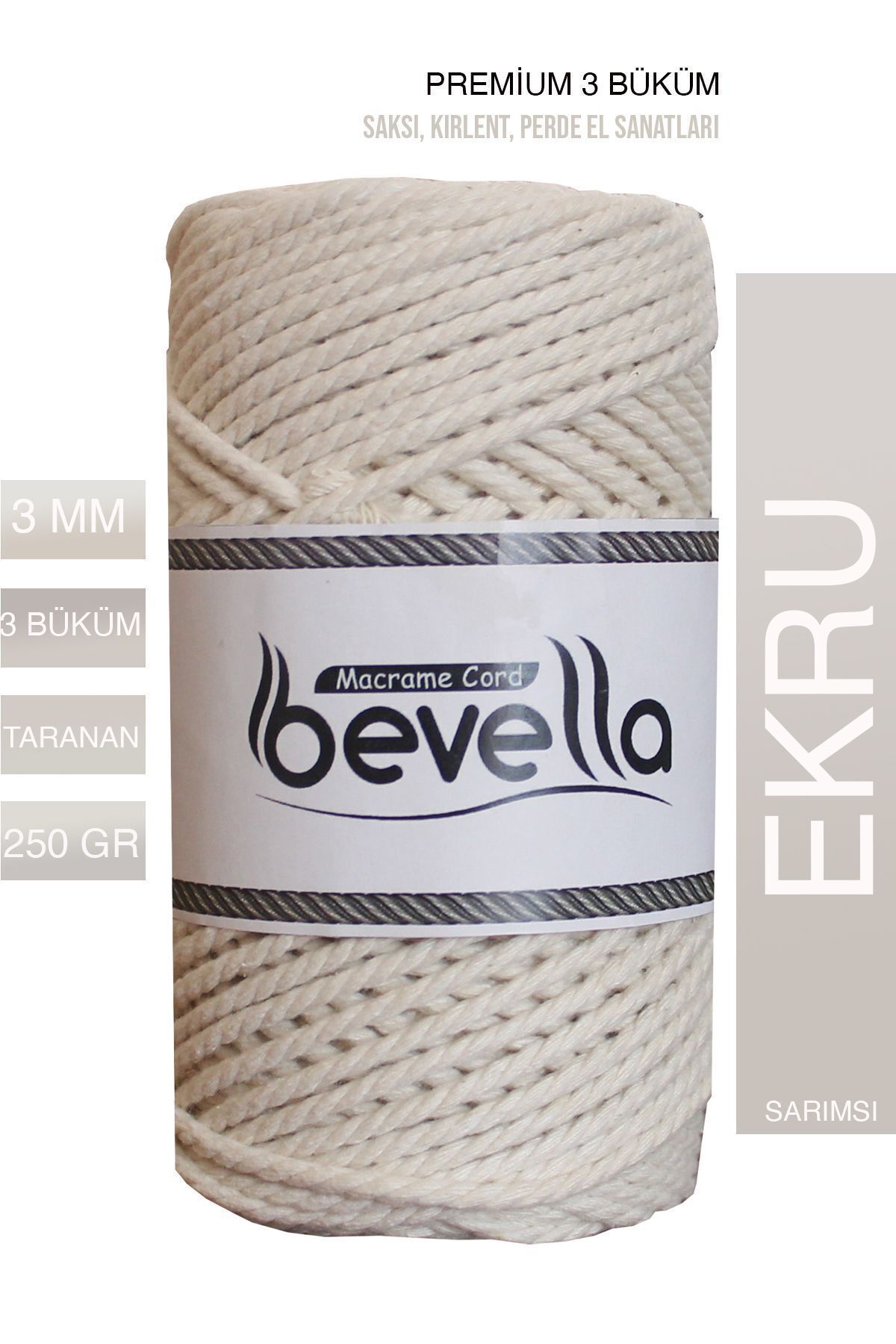
Cord built from three smaller strands twisted tightly together, the most common construction in modern macrame. Each ply contains many smaller fibers, and the three plies wrap around each other in a single direction. 3-Ply Twisted Cord combs into wavy fringe when untwisted.
Braided Cord
Cord made by braiding 8-10 individual fiber strands into a tubular hollow or solid structure. Braided Cord is strong, smooth, and holds shape under stress, but cannot be combed into fringe. Common in bag handles, jewelry, and structural pieces.
Diameter
The thickness of the cord measured across, expressed in millimeters. Macrame cord runs from 1mm (jewelry) to 12mm (sculptural installations), with 3mm and 5mm being the two most common sizes for home decor.
Filler Cord
A passive cord that sits in the center of a knot while other cords wrap around it. Filler Cords carry no tension force and add bulk to a finished knot. Square knots typically use two filler cords and two Working Cords.
Kufi Cord
A thick, multi-ply twisted cotton cord with a tight semi-rigid hand, manufactured primarily in Turkey. Kufi Cord runs in 5mm to 9mm diameters and produces sharp architectural knot definition. It does not comb into soft fringe.
Ply
A single strand of twisted fibers that combines with other plies to form a finished cord. A 3-ply cord has three plies, a 5-ply cord has five. Higher ply counts generally produce stiffer, stronger cords.
Single Twist (Single Strand)
Cord made from many small cotton threads twisted loosely into a single strand without internal braiding. Single Twist cord is exceptionally soft and combs into the smoothest, straightest fringe of any cord type. It is also the most fragile and not recommended for beginners practicing knots.
Tex / Denier
Industrial measurements of fiber weight per length, used by manufacturers to spec cord. Higher tex or denier means heavier, thicker cord. Most retail macrame cord is sold by diameter (mm) instead of tex, but wholesale buyers may see these numbers on technical sheets.
Twist Density
The number of twists per meter of finished cord, a key driver of stiffness and knot definition. Kufi Cord runs at 60-90 twists per meter, while standard 3-Ply Twisted Cord runs at 30-40. Higher twist density produces sharper knots and stiffer feel.
Z-Twist and S-Twist
Two directions of cord twist named after the slant of the fibers when held vertically. A Z-Twist cord has fibers slanting like the middle of a Z; an S-Twist slants like the middle of an S. Most modern macrame cord is Z-twist, but matching twist direction matters when joining two cords for a clean appearance.
Knot Terms
A pattern that names ten knots is usually five base knots arranged in different combinations and sequences. The square knot, lark's head, double half hitch, spiral, and gathering knot anchor most beginner and intermediate patterns; the rest are stylistic variants of these five. The ten terms below cover the knot vocabulary used in roughly 95% of beginner and intermediate macrame patterns, with a one-line definition of each.
Alternating Square Knot
A pattern in which square knots in one row are offset from the row above, splitting and rejoining cords as you go down. Creates a diamond mesh effect across a wider piece. Used heavily in plant hangers, table runners, and large wall hangings.
Berry Knot
A clustered decorative knot made by stacking 3-4 Square Knots tightly and folding them upward to form a small bump. Adds dimensional texture to flat work. Often used as accents in wall hangings.
Double Half Hitch
Two consecutive Half Hitches worked in the same direction on the same anchor cord, producing a ridged horizontal or diagonal line across the work. Double Half Hitch is the foundation knot for diamond and V-shape patterns.
Gathering Knot (Wrap Knot)
A knot made by wrapping one cord tightly around a bundle of cords and tucking the tail under the wraps. Gathering Knots finish the tops of plant hangers and group cords at decorative points. Also called a Wrap Knot.
Half Hitch
A simple loop knot in which one cord wraps once around another anchor cord. Two half hitches form a Double Half Hitch. Pattern instructions sometimes call this a "single half hitch" to distinguish from the double.
Half Square Knot (Spiral Knot)
The first half of a Square Knot repeated continuously, which causes the work to twist into a spiral. Used to make spiral plant hanger arms, tassel cords, and decorative twists.
Lark's Head Knot
A starter knot used to attach folded cord onto a dowel, ring, or anchor cord. Most macrame patterns begin with a row of Lark's Head Knots as the foundation. Reverse versions hide the bump on the back of the work.
Overhand Knot
The simplest possible knot, made by passing a cord end through a loop. Used to finish tassel ends, secure beads, and stop fringe from unraveling. The first knot most people learn outside of macrame.
Square Knot
The most common decorative knot in macrame, made by tying a left and right Half Square Knot in alternating directions. Two outer Working Cords wrap around two inner Filler Cords. Forms the basis of plant hangers, wall hangings, and most flat patterns.
Working Cord
An active cord that wraps, ties, or moves around other cords to form a knot. Working Cords carry the tension that pulls the knot tight. In a Square Knot, the two outer cords are working cords and the two inner cords are Filler Cords.
Tool Terms
Macrame is a low-tool craft, but knowing the right name for each tool speeds up shopping and pattern reading. These six terms cover the tools that appear in most patterns.
Dowel
A round wooden rod used as the top anchor of a wall hanging or curtain piece. Dowels typically run 30-100 cm long and 1-3 cm thick. Some patterns substitute driftwood, copper pipe, or metal rings.
Fid (Lacing Tool)
A pointed wooden or plastic tool used to dress thick knots and pry open tight loops. A Fid becomes essential at 8mm cord and above, where finger tension alone cannot tighten knots cleanly. Also called a lacing needle or marlinspike.
Foam Board
A stiff foam panel used as a flat working surface for pinning small projects in place. Foam Board lets you fix work onto a horizontal table while maintaining tension. Common in jewelry-scale macrame and mandala patterns.
S-Hook
A simple S-shaped metal hook used to hang a Dowel or work-in-progress from a curtain rod or wall hook. S-Hooks let you raise and lower the work as you tie down the piece.
Wide-Tooth Comb
A coarse-toothed comb used to brush out cord ends into smooth or wavy fringe. A standard plastic Wide-Tooth Comb from a hair-supply store works for most cord up to 5mm. Pet groomer slicker brushes work for thicker cord.
Work Surface
The dowel, ring, board, or anchor system that holds the cord taut while you knot. Common Work Surfaces include a wall hook plus dowel, a chair back, a foam board, or a portable macrame stand.
Project Terms
Project vocabulary covers the parts of a finished macrame piece and the way patterns describe overall construction. These eight terms appear most often in pattern instructions and finished-piece descriptions.
Anchor
The fixed point a project hangs from while being knotted. An Anchor might be a Dowel, ring, key fob, or another cord stretched horizontally between two points. Anchor choice shapes the top of every piece.
Fringe
The loose cord ends below the last row of knots, often combed out for decorative effect. Fringe length runs from 5 cm on a small wall hanging to 40 cm on a large statement piece. Fringe finishing technique heavily affects the final look.
Knot Drop
The vertical distance between two horizontal rows of knots. Knot Drop control is what makes a pattern look proportionate; uneven drop is a top-three beginner mistake. Patterns specify knot drop in centimeters or as a count of cord wraps.
MOQ (Minimum Order Quantity)
A wholesale term meaning the smallest order a manufacturer will fulfill. Cord MOQ is typically 10 kg per color for stock natural and 50-100 kg for custom-dyed. MOQ matters when comparing wholesale suppliers.
Negative Space
Areas of a finished piece intentionally left without knots, where cords hang freely. Negative Space gives a wall hanging visual rhythm and breaks up dense knot patterns. A common feature of intermediate and advanced designs.
Pattern Repeat
A unit of knots that repeats horizontally or vertically across a piece. Patterns describe a project as "pattern repeat: 4 cords across, 6 rows deep." Counting pattern repeats helps buy the right amount of cord.
Stationery Cord
A cord that stays in one place and acts as a reference line for surrounding knots, often a horizontal cord across the top of a row. Diagonal Half Hitch rows are typically tied around moving stationery cords. Sometimes spelled "stationary cord."
Tassel
A bundle of cord secured at one end with a Gathering Knot and free at the other. Tassels finish the bottoms of plant hangers, decorate keychains, and accent gift wrapping. The simplest macrame project for absolute beginners is a single tassel.
Frequently Asked Questions About Macrame Terminology
What is the difference between cord, rope, and string in macrame?
Cord is a general term covering most macrame materials. Rope usually means thicker construction (typically over 6mm) with multiple plies braided or twisted, while string usually means thin, single-twist cord under 2mm. Most patterns use cord as the umbrella term, but pattern designers often use rope and string interchangeably.
What does "ply" mean in macrame cord?
Ply refers to the individual twisted strands inside a finished cord. A 3-ply cord contains three smaller plies twisted around each other. Higher ply counts generally produce stiffer, stronger, more uniform cords with sharper knot definition.
Why does my pattern call some cords working and others filler?
A working cord moves and ties knots, while a filler cord stays still and gets wrapped around. In a square knot, the two outer cords work and the two inner cords fill. The distinction matters when calculating cord lengths because working cords use 4-5x the finished length while filler cords use only 1.5-2x.
What is the most common knot in macrame patterns?
The square knot is by far the most common knot in modern macrame patterns. It anchors plant hangers, wall hangings, table runners, bookmarks, and most flat designs. Most beginner patterns combine the square knot with the lark's head, half hitch, and gathering knot.
What does MOQ mean for wholesale macrame cord?
MOQ stands for minimum order quantity, the smallest amount a manufacturer will sell at wholesale rates. For Turkish cotton macrame cord, MOQ typically starts at 10 kg per color for stock natural and rises to 50-100 kg for custom dye. Manufacturers like Bevella publish current MOQ on their wholesale price sheets.
Are kufi cord and standard twisted cord interchangeable in patterns?
No. Kufi cord uses 5-6 plies and runs much stiffer than standard 3-ply twisted cord, so substituting it changes both the look and the cord-length math. Patterns written for 3-ply cotton produce too-tight, too-bulky knots when knotted in kufi at the same cord lengths.
Bookmark this glossary as a reference and pull it up the next time a pattern uses an unfamiliar term. Reading patterns gets dramatically faster once these 40 terms feel automatic, and most intermediate pattern designers assume readers already know the vocabulary in this list. From here, the next step is reading a real pattern and pausing only to look up the few terms that still feel new.
Sources cited in this article: Craft Industry Alliance Onward and Upward Survey 2024, Customcy Handmade and Craft Industry Statistics for 2026, Macrame for Beginners (Cord Guide), industry comparison, cord specifications, industry guides industry cotton reports.